

Fabrication & Supply of Mooring Components
With over 30 years of experience, we offer end-to-end fabrication and global supply of high-performance mooring components engineered for offshore oil & gas, floating production systems, and floating offshore wind turbines (FOWTs). Our extensive inventory and supplier network ensure the availability, traceability, and timely delivery of critical equipment — tailored to your project requirements.
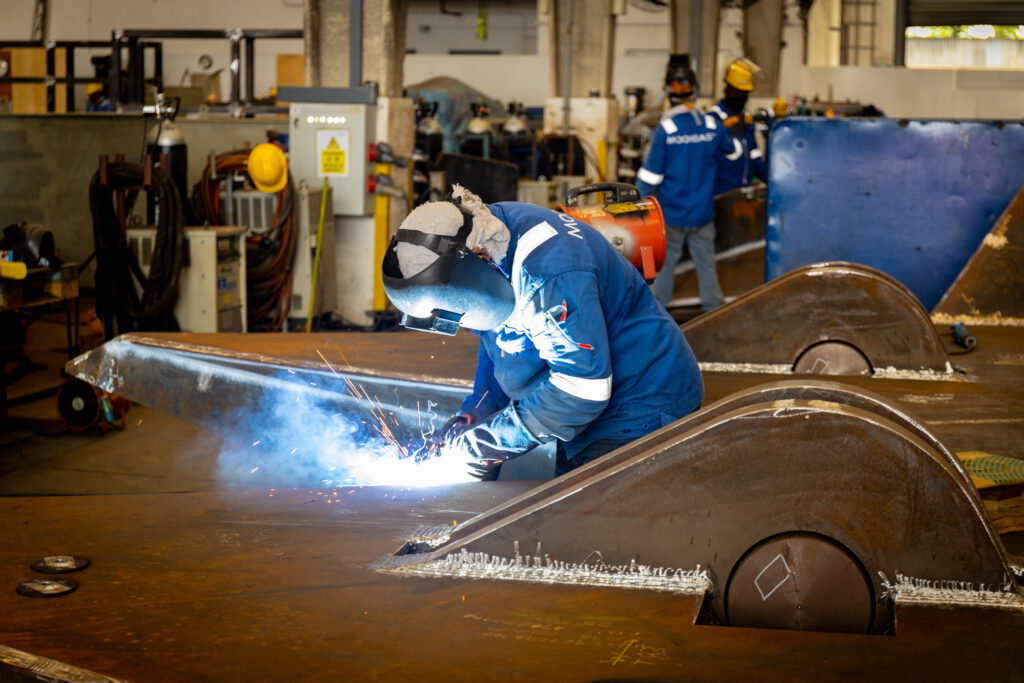
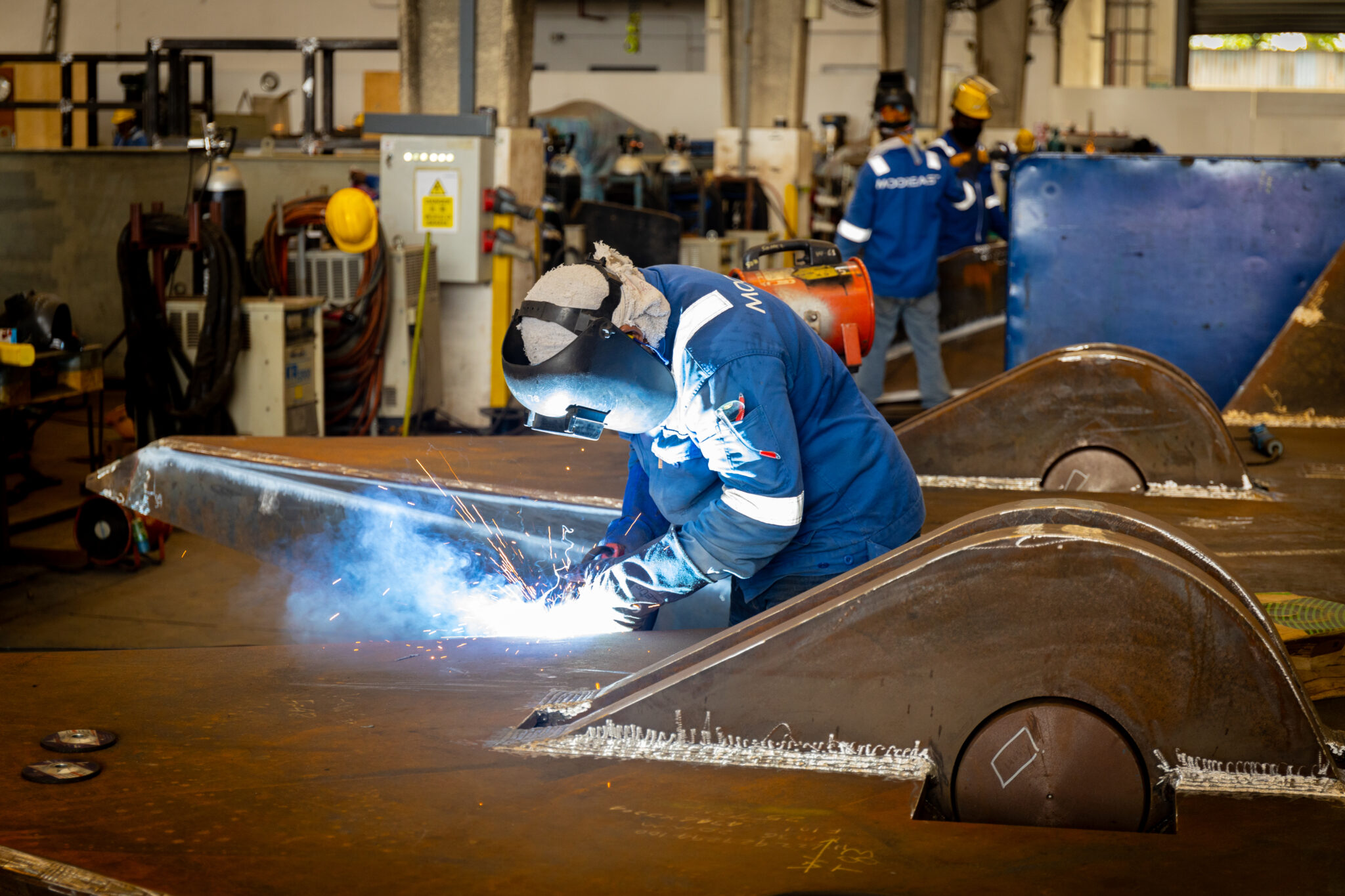
Main fabrications are performed in our facilities in Singapore. Strategically positioned in the Asia Pacific region, our expansive facilities encompass 32,000 m2 of functional space dedicated to steel fabrication, testing services and consolidation of equipment. With a 192 m water-front, our location facilitates direct loading of equipment onto vessels, eliminating the need for trucking to ports.

.
Drag Embedment Anchors
Mooreast, understands that the strength of your offshore project lies in its foundation. As a leading mooring solution specialist and one of only three ultra high holding power anchor designers worldwide, we provide “Total Mooring Solutions” with in-house design, engineering, fabrication, and installation capabilities. Our high-performance Drag Embedment Anchors are engineered to deliver unparalleled station-keeping capability and contribute significantly to the stability of your floating offshore structures, from floating production, storage and offloading vessels to floating wind turbines.
Proven Resilience
Mooreast drag embedment anchors have a remarkable track record, exemplified by their successful deployment in the Fukushima Forward Offshore Wind Turbine Project in Japan. These anchors helped the project’s 2MW, 5MW, 7MW floating wind turbines, and the floating substation successfully withstand several typhoons and earthquakes from their installation in 2012/13 until decommissioning in 2022/23
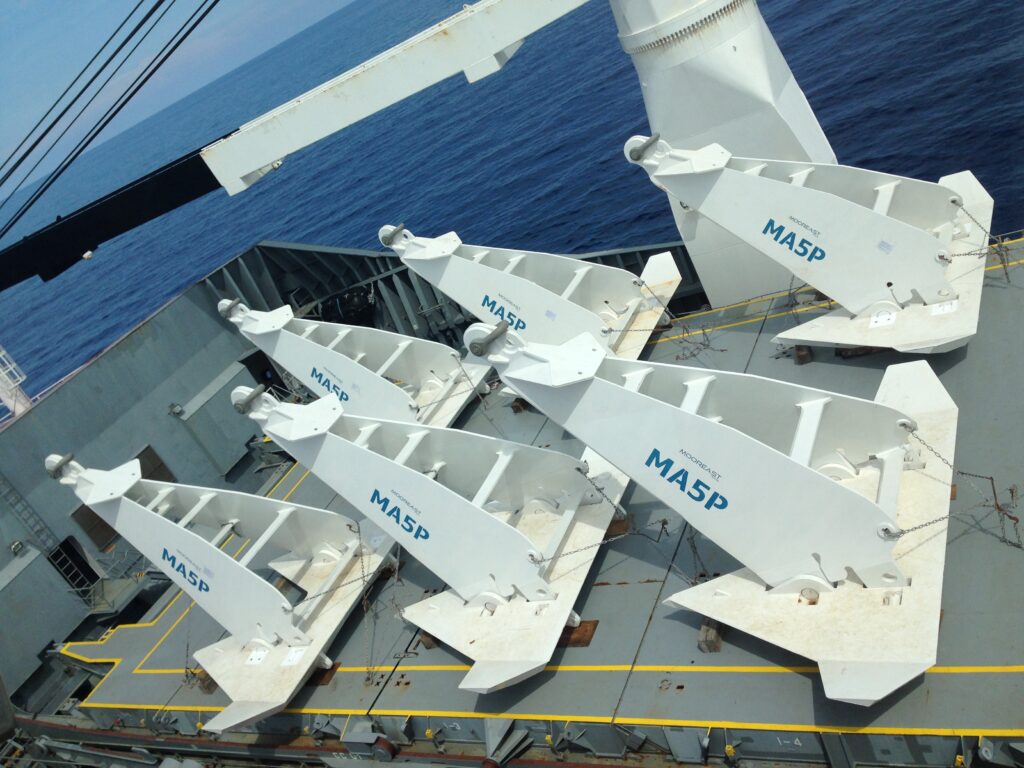
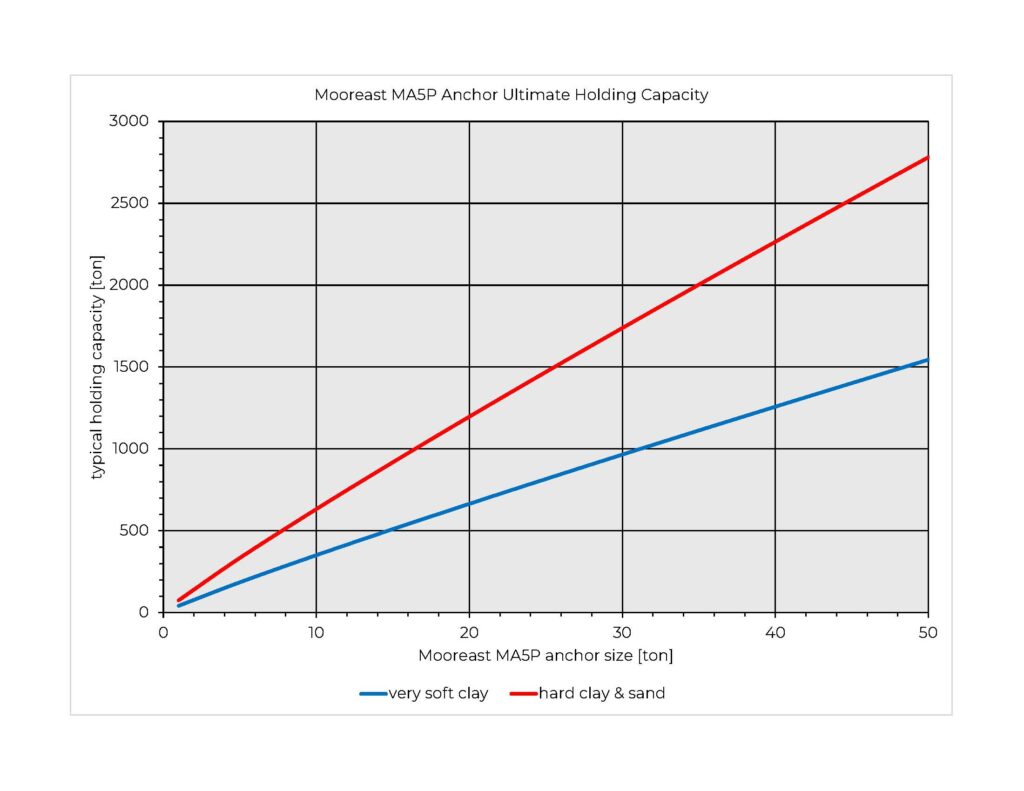
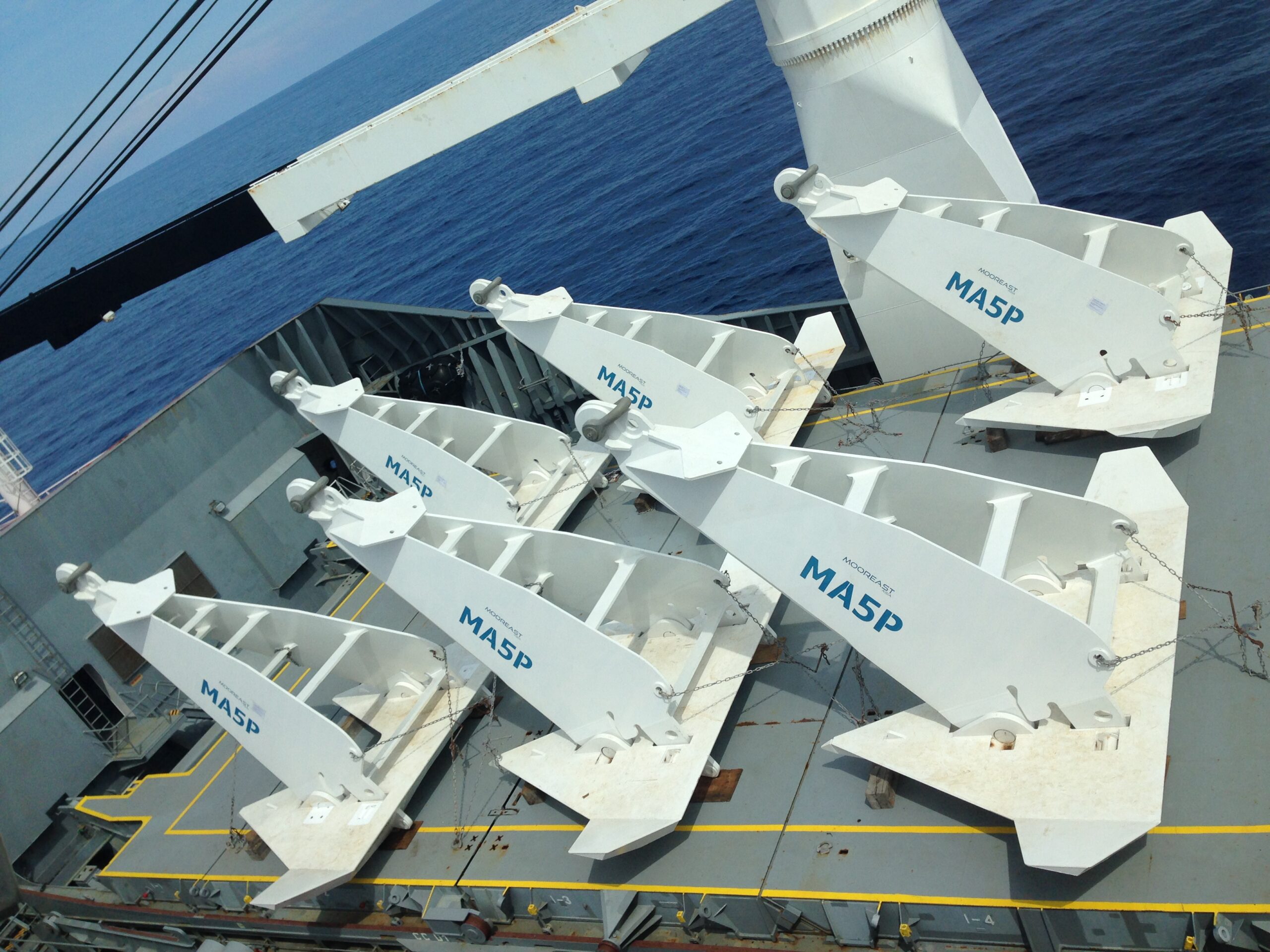
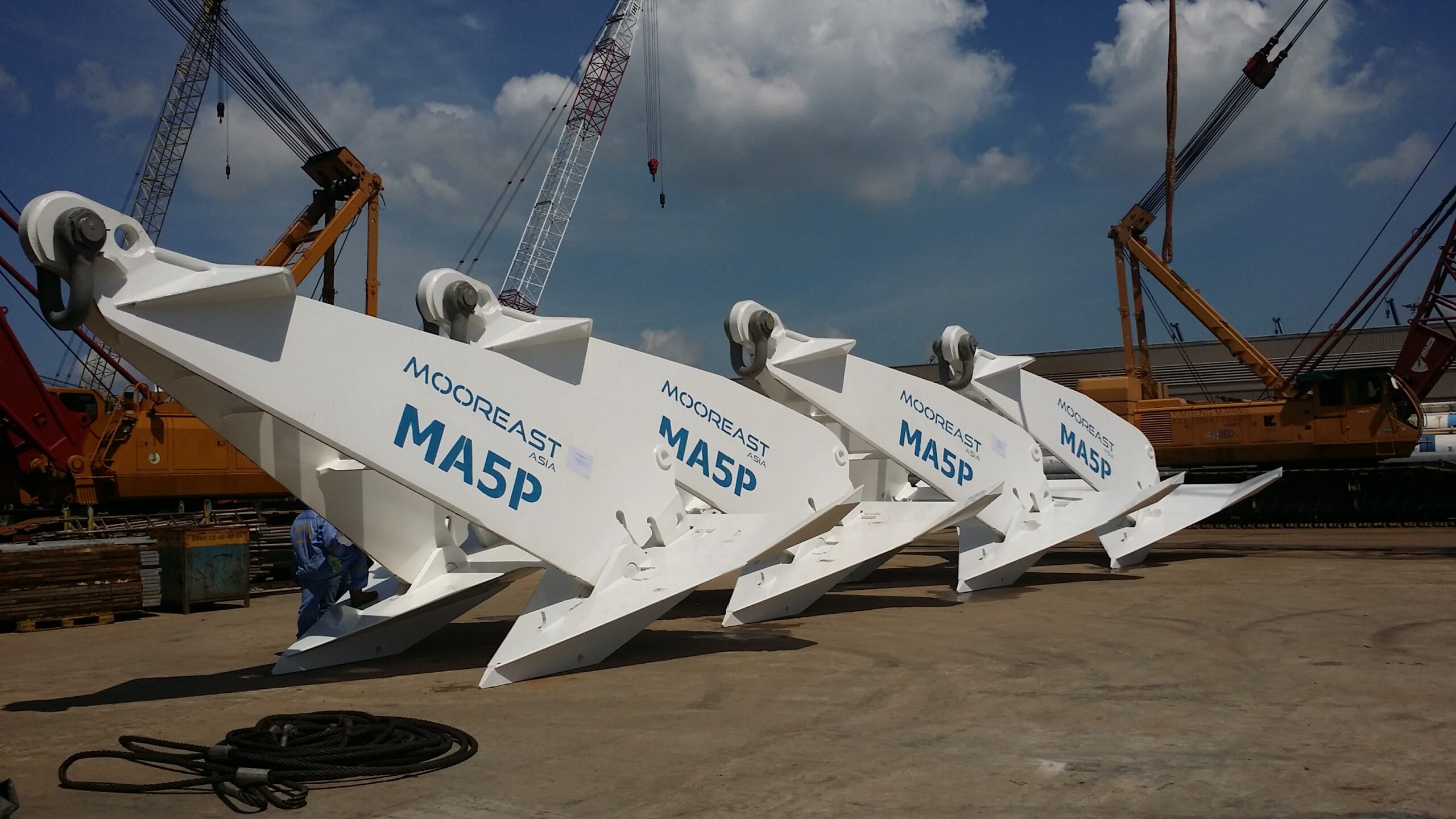
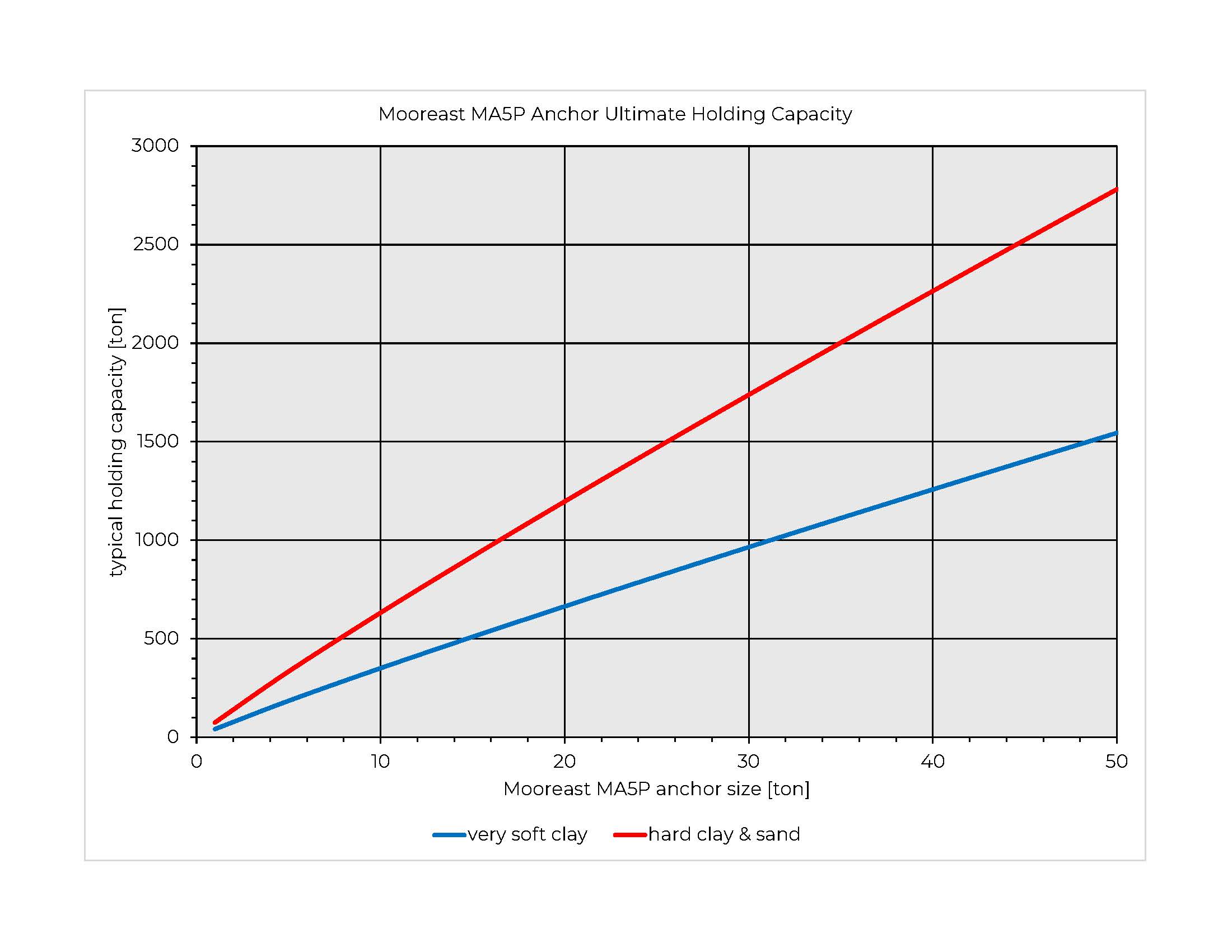
MA5P
With unrivalled holding power and adaptability to diverse soil conditions, the Mooreast MA5P drag embedment anchor stands as a beacon of reliability, ensuring the safety and stability of your assets even in the most challenging offshore environments. Its distinctive design features a large fluke area and slender open twin shank, meticulously crafted to minimize soil disturbance while enabling deeper penetration.
- Suitable for variety of soil conditions
- Easy to install using anchor handling tugs
- A holding capacity of more than 50x times its own weight, depending on the seabed conditions
- Approved design by all major classification societies
- Easy decommissioning and reusability
- Suitable for uplift loading
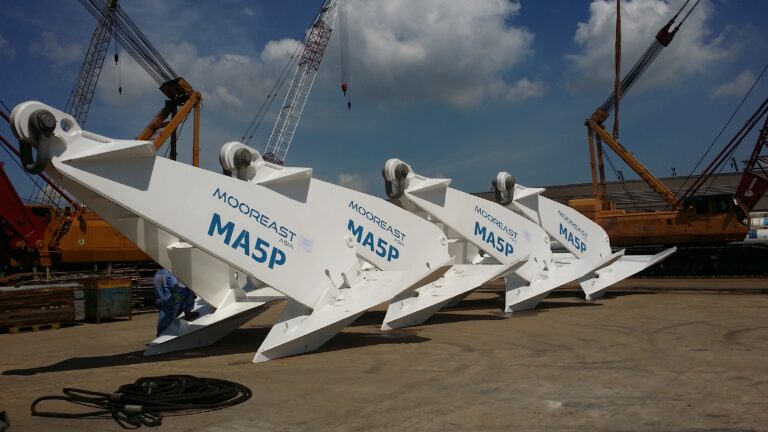
Whether navigating through soft seabeds or encountering varying soil conditions, the MA5P drag embedment anchor is designed to meet the demands of diverse environmental conditions.
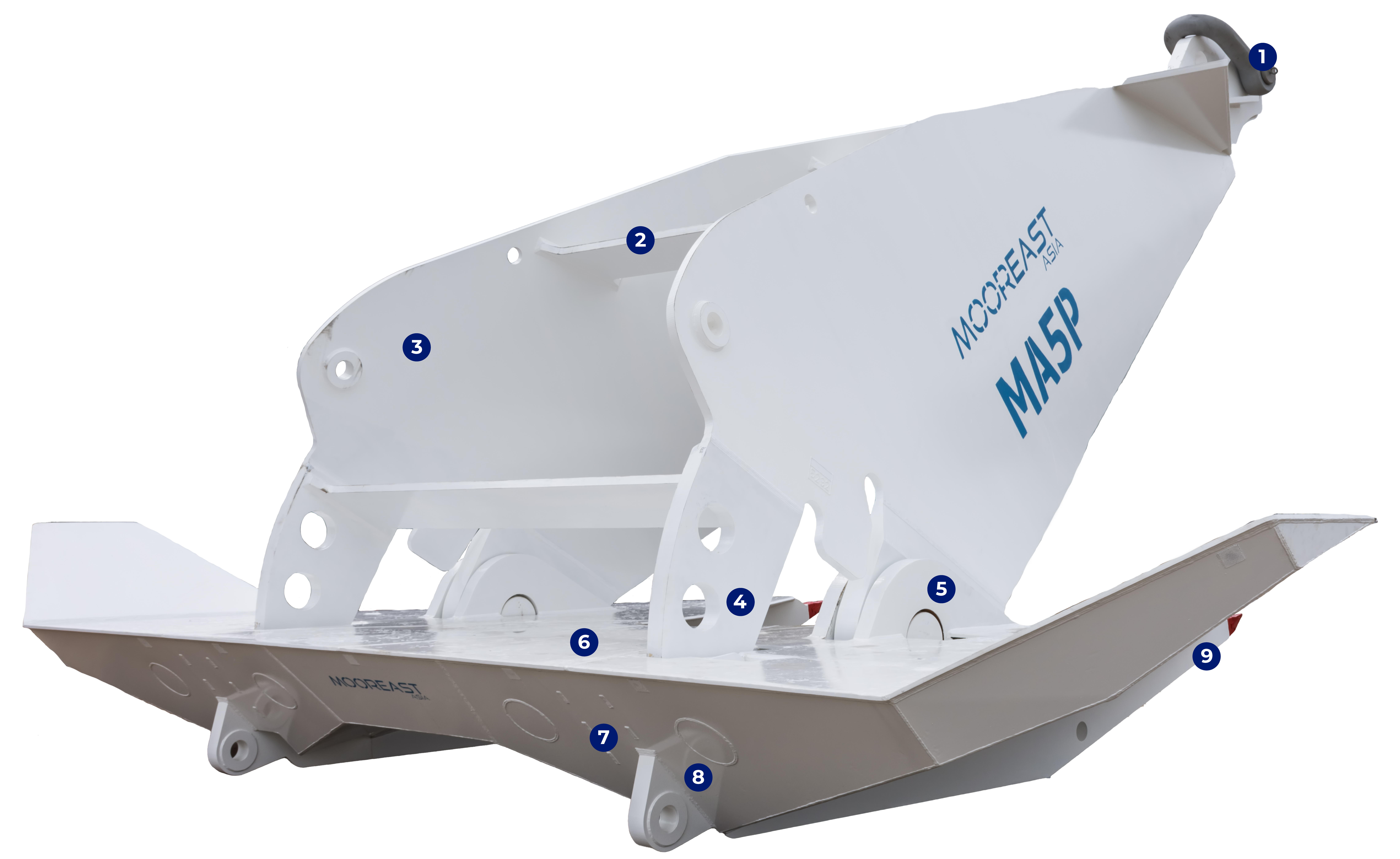
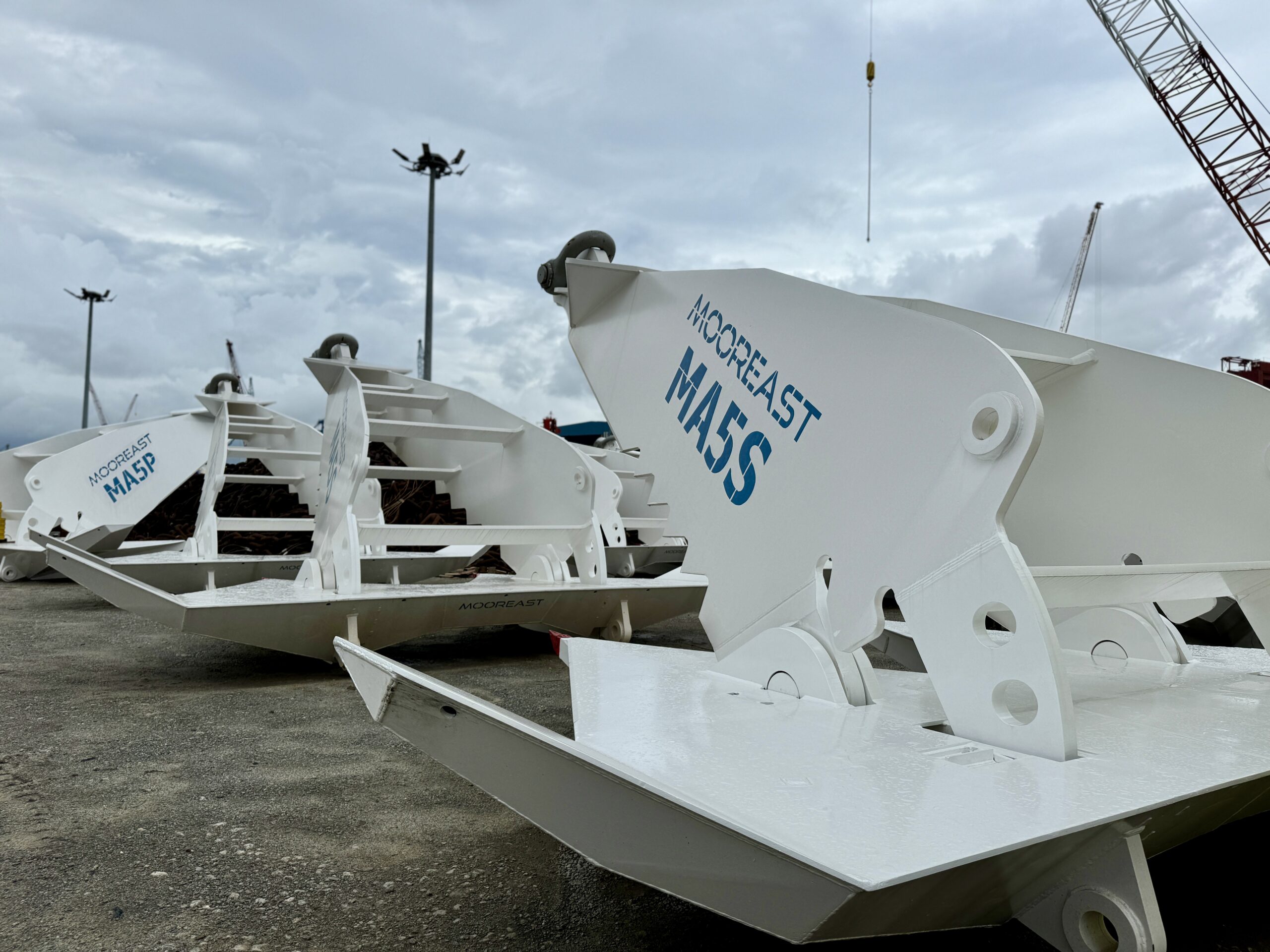
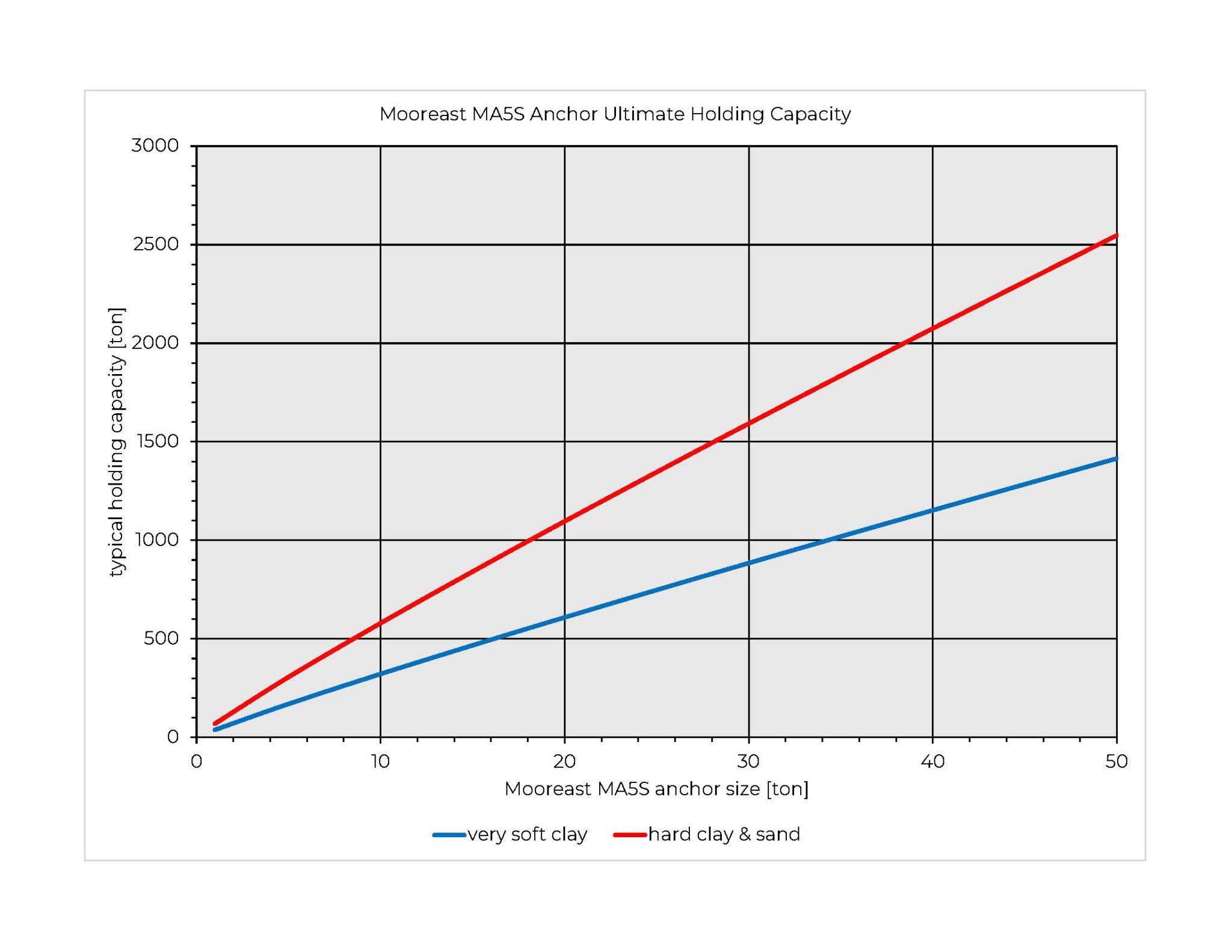
MA5S
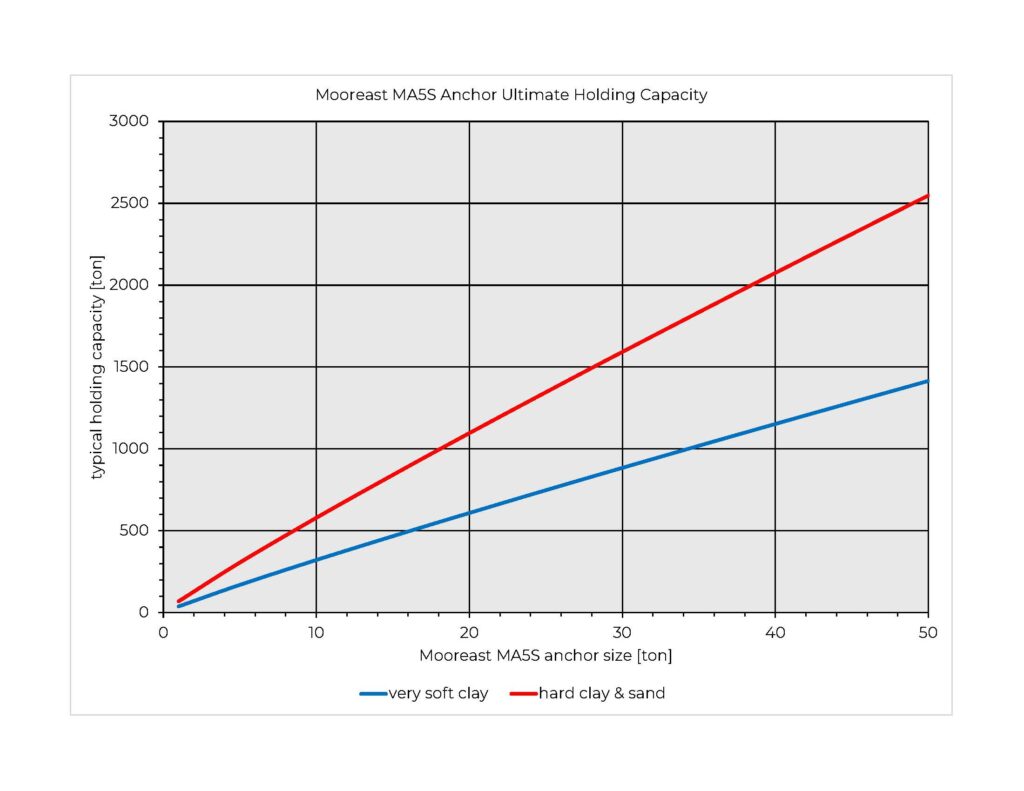
The Mooreast MA5S drag embedment anchor is an innovative enhancement of the renowned Mooreast MA5P anchor, meticulously designed to excel in challenging environments such as calcarenite, very dense sands, and coral.
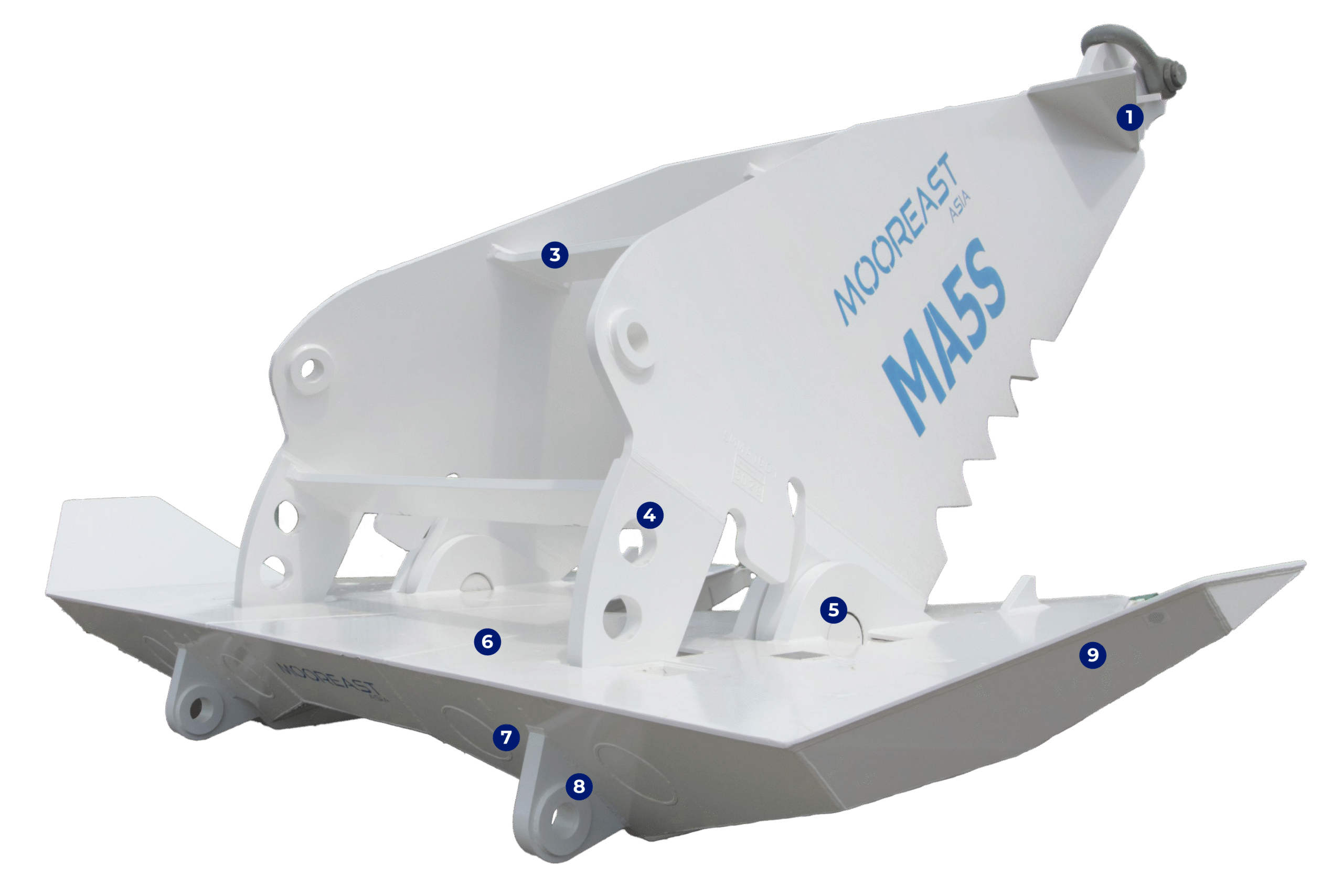
Featuring shark-like teeth on the shank and optional robust cutter point tips on the fluke, the MA5S anchor ensures superior penetration into tough soils. Additionally, its hollow fluke can be ballasted for enhanced penetration capabilities.
- Designed for hard soil conditions
- Can be loaded on the fluke tips only
- A holding capacity of more than 50x times its own weight, depending on the seabed conditions
- Stronger structural design
- Easy decommissioning and reusability
- Suitable for uplift loading
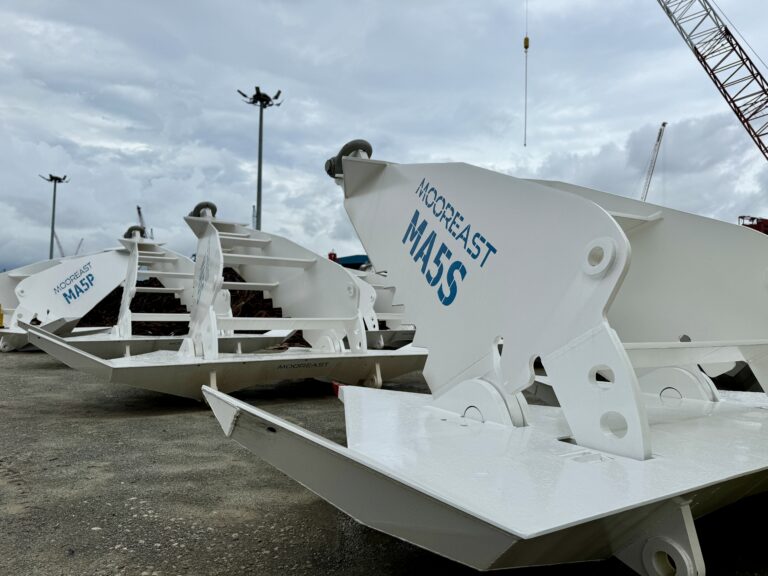
Shark-like teeth on the shank and optional strong cutter point tips on the fluke to assist with penetration into hard soils such as calcarenite, very dense sands and coral.
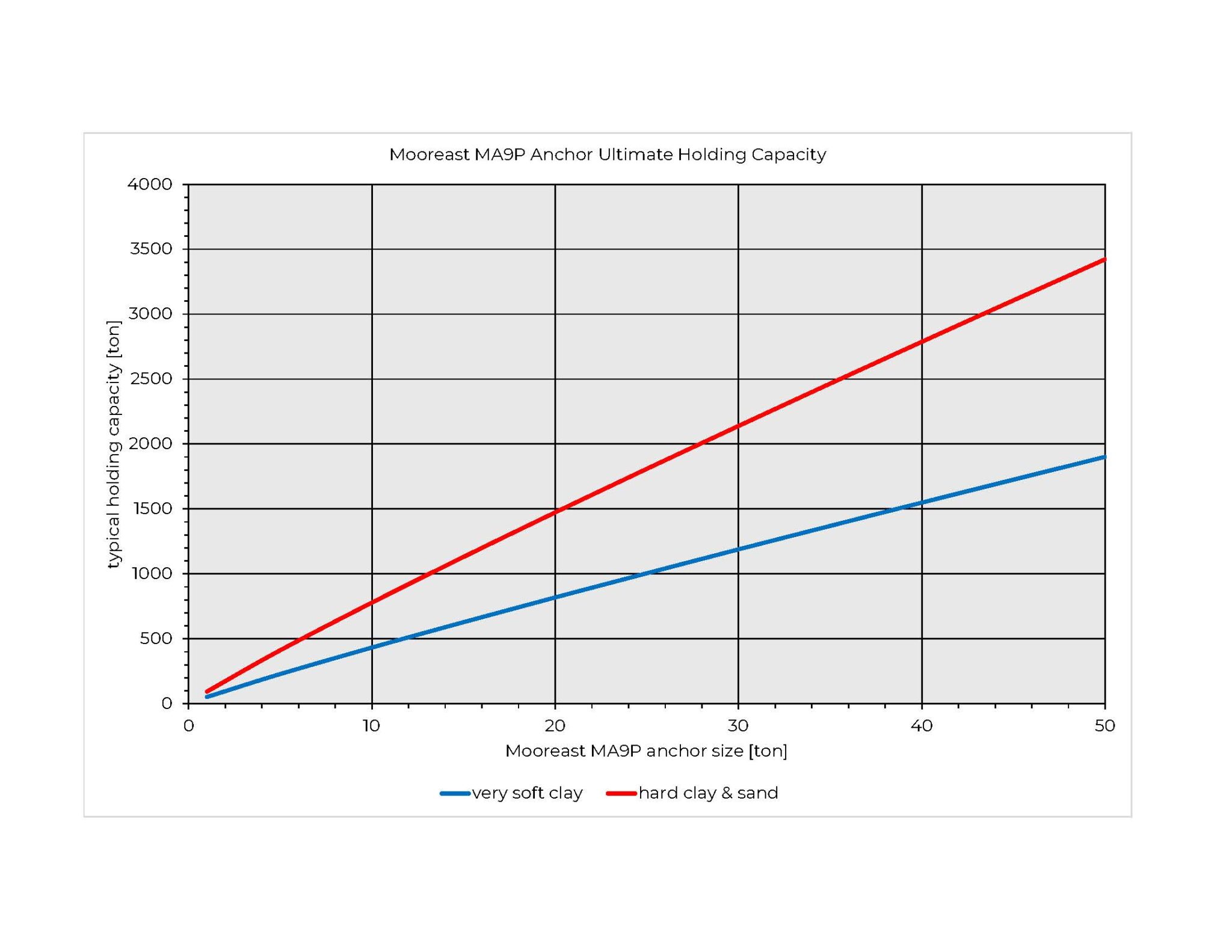
MA9P
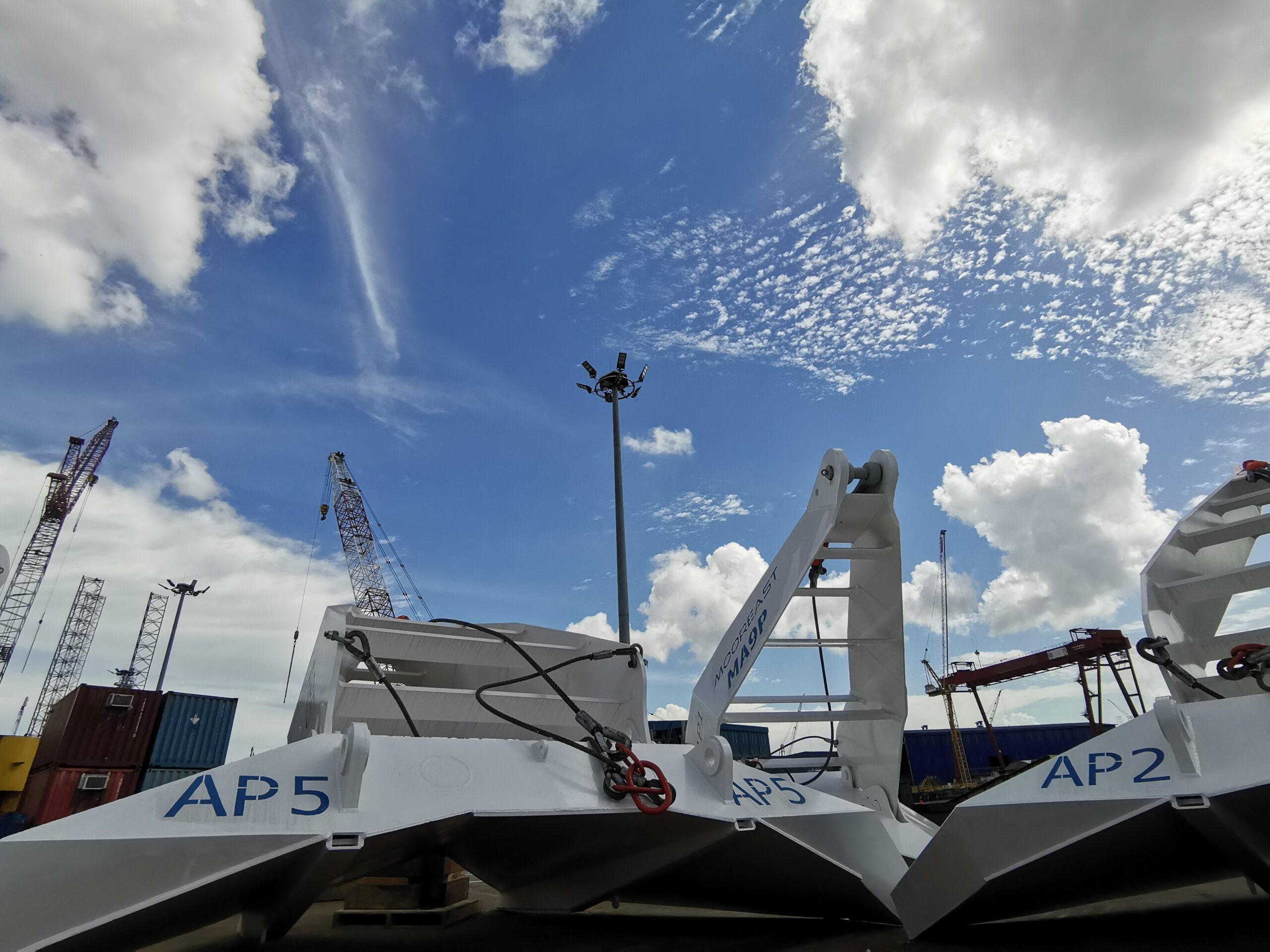
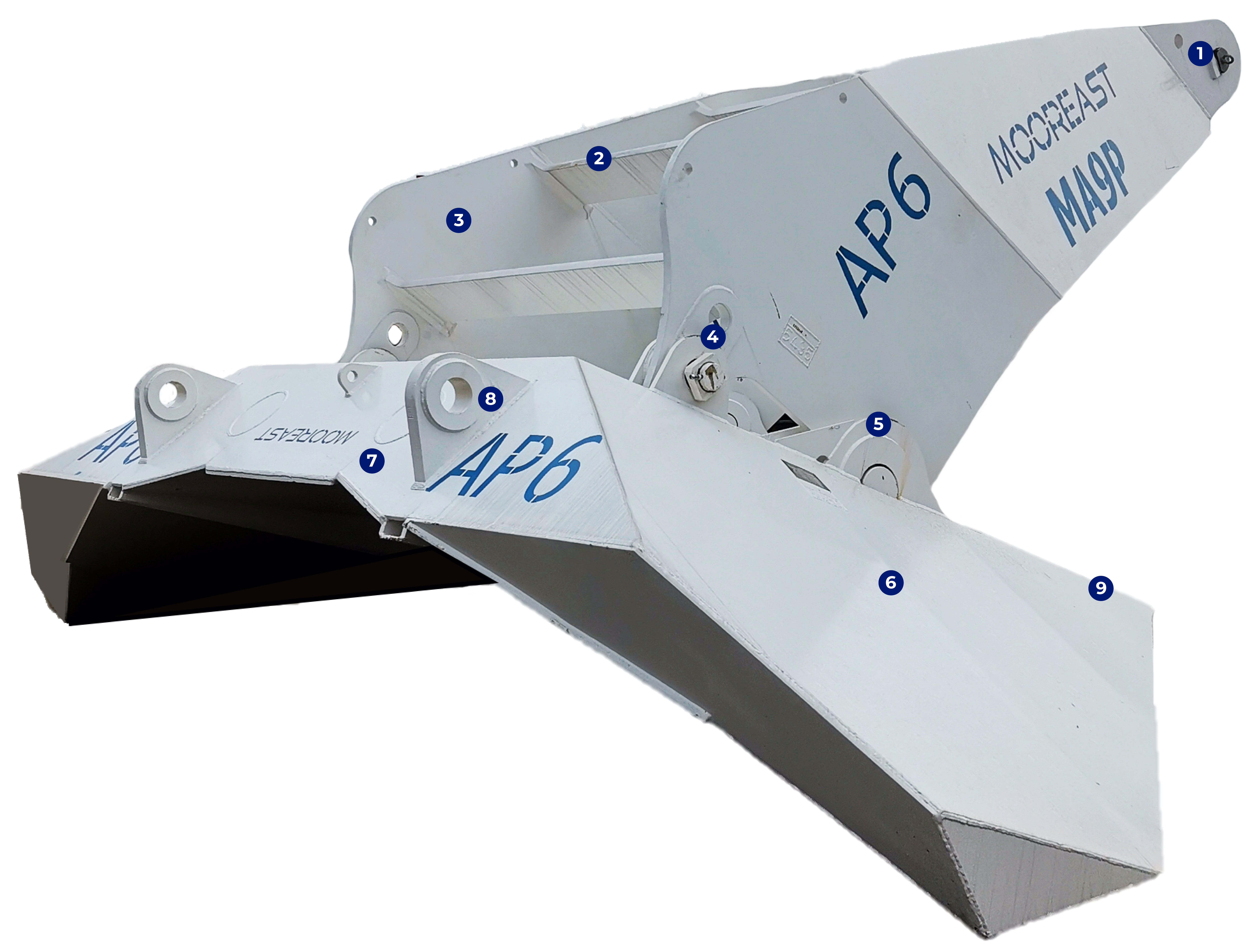
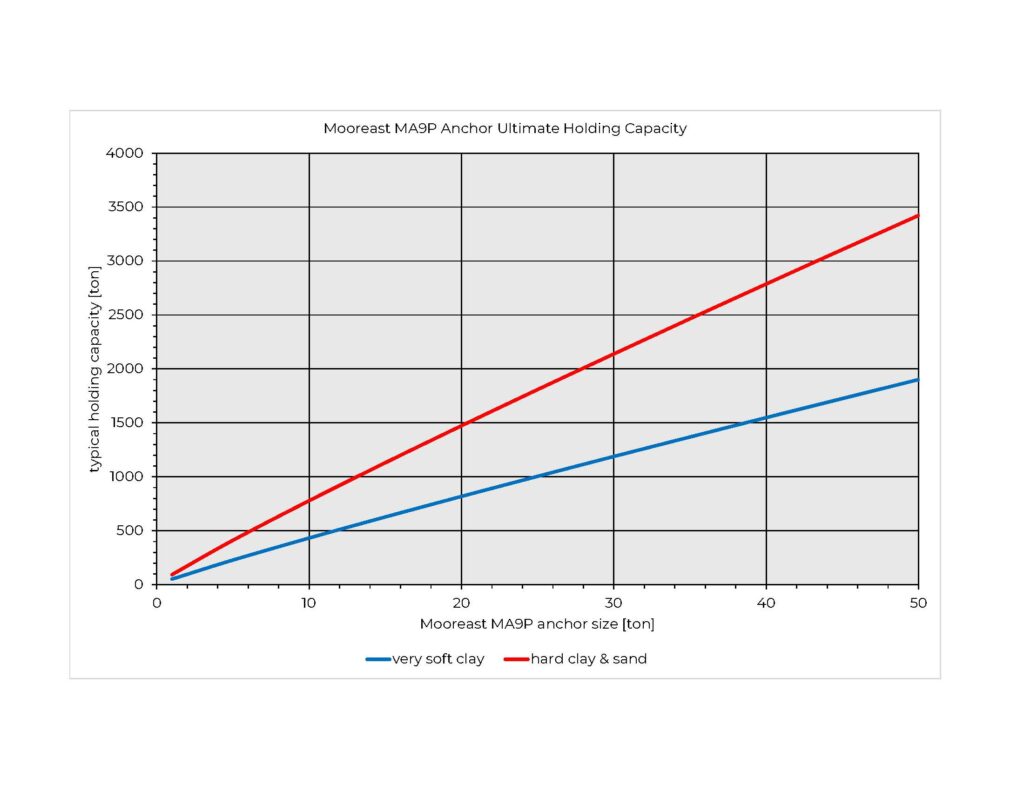
The Mooreast MA9P drag embedment anchor is the state-of-the-art design for optimum holding capacity to weight ratio. Having a holding capacity of more than 80x its own weight, the Mooreast MA9P design is structurally different from the MA5 series. In recent years, the Mooreast MA9P has also become a preferred choice in the Floating Offshore Wind Turbine (FOWT) sector due to its holding capacity performance and reliability in varying seabed and environmental conditions.
- Suitable for variety soil conditions
- Optimized fluke geometry for improved holding capacity
- A holding capacity of more than 80x times its own weight, depending on the seabed conditions
- Suitable for uplift loading
State-of-the-art design for optimum holding capacity to weight ratio of more than 80x.
Suction Piles
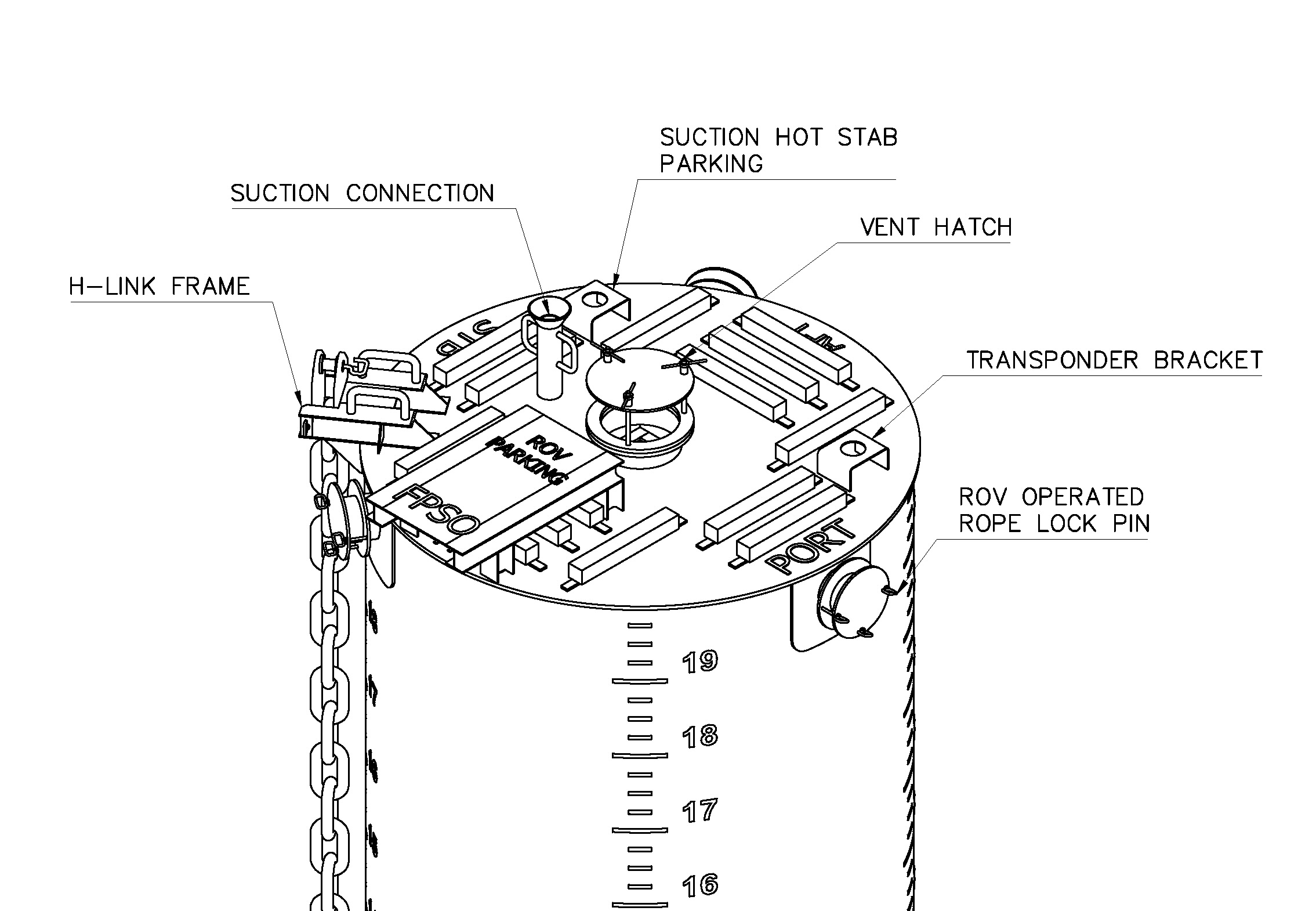
Suction piles are cylindrical steel foundations installed by pumping water out from inside the pile to create a pressure differential, allowing the pile to embed itself into the seabed. Once installed, they resist vertical, lateral, and uplift loads, making them ideal for permanent mooring in soft clay and deepwater environments.
Design Variations
We offer customizable suction pile designs based on:
- Diameter: Typically ranges from 2 m to 10 m
- Length (Embedment Depth): Up to 20+ meters, depending on soil and load
- Wall Thickness: Optimized for structural integrity
- Top Plate Configurations:
- ROV operatable bottom chain connection interface
- ROV interface panels for installation support
- Lifting trunnions and guide frames
- Materials & Coatings: Offshore-grade steel with Classification Society compliance
Key Benefits
- Cost-effective installation using suction (no hammering required)
- No pile driving noise – environmentally friendly
- Removable and reusable (suitable for decommissioning or relocations)
- Integrated with ROV-friendly interfaces for subsea installation
Driven Piles
Driven piles are steel tubular piles installed by impact hammers that drive them deep into the seabed. These anchors provide robust resistance to axial and lateral loads and are a well-established solution for both shallow and deepwater permanent mooring systems.
Design Variations
We supply driven piles in various configurations, tailored for:
- Pile Diameter: Ranging from 0.6 m to 10.0 m
- Length: Up to 30 m or more, depending on soil layers
- Tip Design:
- Open-ended
- Pointed driving shoes for hard soils
- Connection Interface:
- Casted, forged or fabricated padeye with internal stiffeners
- ROV operatable bottom chain connection interface
Key Benefits
- Proven technology with decades of track record in oil & gas and marine infrastructure
- Suitable for dense soil and mixed strata where suction is less effective
- High axial and lateral capacity, supporting up to taut mooring design
- Permanent foundation solution
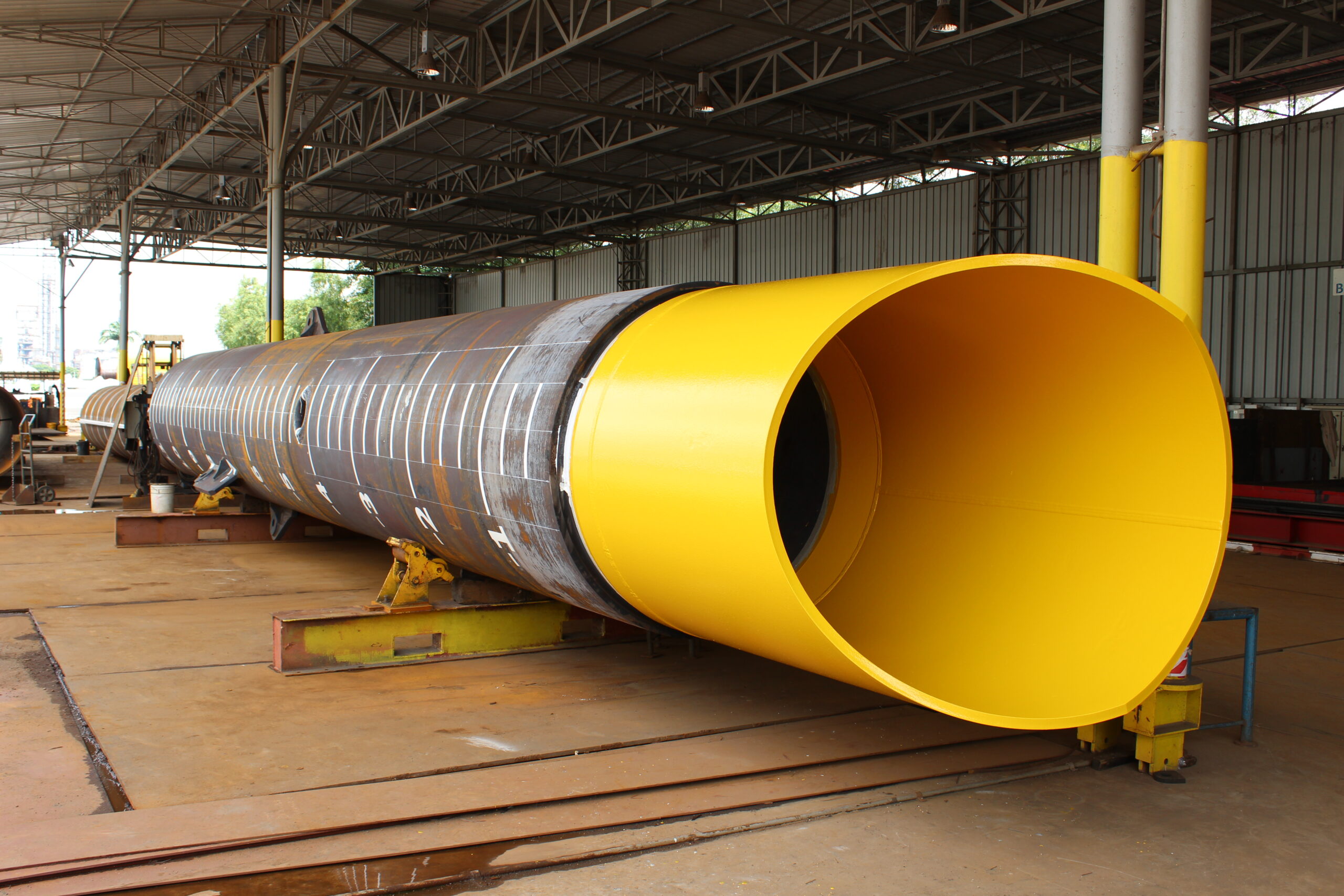
Gravity Anchors
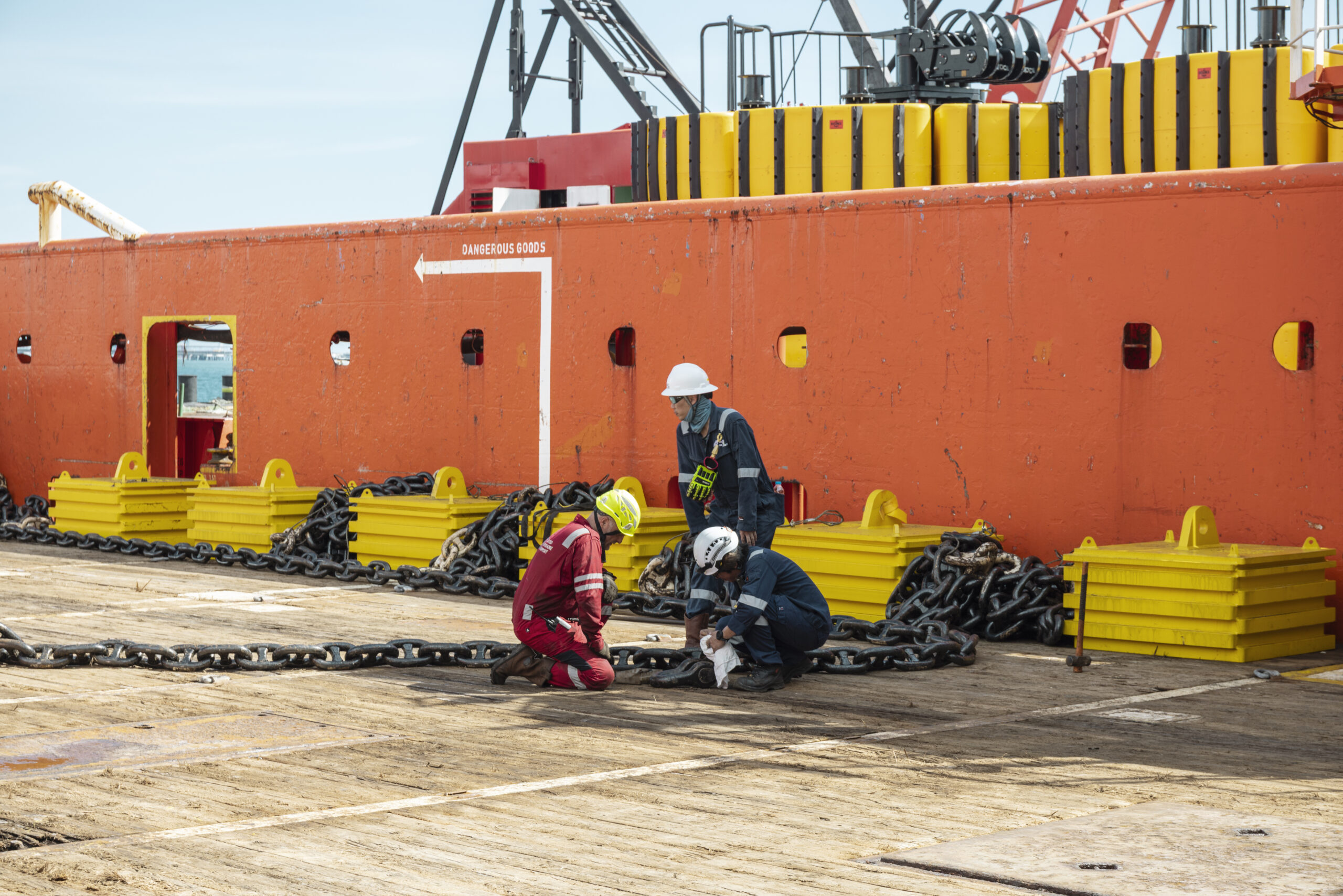
As part of our mooring component supply, we provide a full range of gravity base anchors (GBAs)—engineered for subsea stability through weight and seabed friction. These anchors are ideal in environments where penetration is restricted or undesirable, such as rocky seabeds, coral zones, or pipeline crossings.
We also offer clump weights and hold-back anchors under the same non-penetrating anchor category, where simplicity and high load-resistance are required with minimal seabed disturbance.
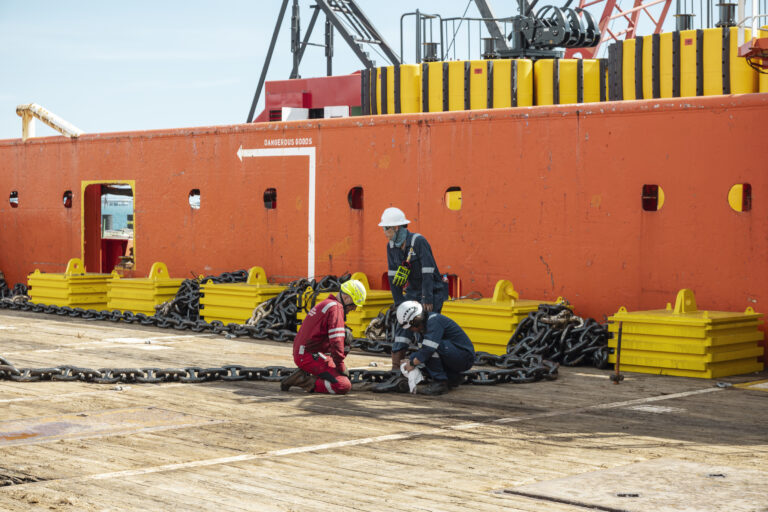
Our gravity-based anchor systems are designed to suit a wide range of mooring needs:
- Steel Gravity Base Anchor (SGBA):
Fabricated entirely from offshore-grade steel, designed for high strength-to-weight ratio and superior handling. - Steel Clump Weights:
Compact mass blocks used to add downward force to the mooring catenary or assist in tension management. - Steel Hold-Back Anchors:
Used to restrain pre-installed mooring lines or flexible risers during tie-in and installation operations.
Why choose steel fabricated gravity anchors?
While concrete GAs have traditionally been used, our full-steel fabrication philosophy brings significant logistical and operational advantages, especially when viewed through the lens of installation and transportation planning.
Installation Benefits:
- Modular construction allows delivery in parts and assembly offshore or nearshore
- Integrated padeyes and guide slots simplify deployment using AHTS or crane vessels
- Reduced seabed preparation time compared to concrete, which often requires leveling or scour protection
- Lower risk of cracking or structural failure under impact during handling
Transportation Advantages:
- Can be stacked or nested efficiently, reducing deck space requirements
- More compatible with standard sea fastening procedures on offshore support vessels
- Easier handling during load-out, lifting and deployments – Avoid hairline cracks which affects integrity of the anchor structure
For temporary mooring, installation hold-back, or secondary anchoring, steel gravity base anchors offer unmatched flexibility without sacrificing performance.
Mooring Chains
While Mooreast does not manufacture mooring chains directly, we are a trusted partner in the procurement, quality assurance, and specification management of mooring chains for permanent offshore mooring systems as part of an EPC of Mooring System package for over 3 decades. Our role is to ensure that every chain delivered to your project site meets the highest standards of strength, durability, and compliance.
Whether you’re securing an FPSO, FPU, or a floating wind turbine (FOWT), the mooring chain is a mission-critical component — and we make sure it’s done right.
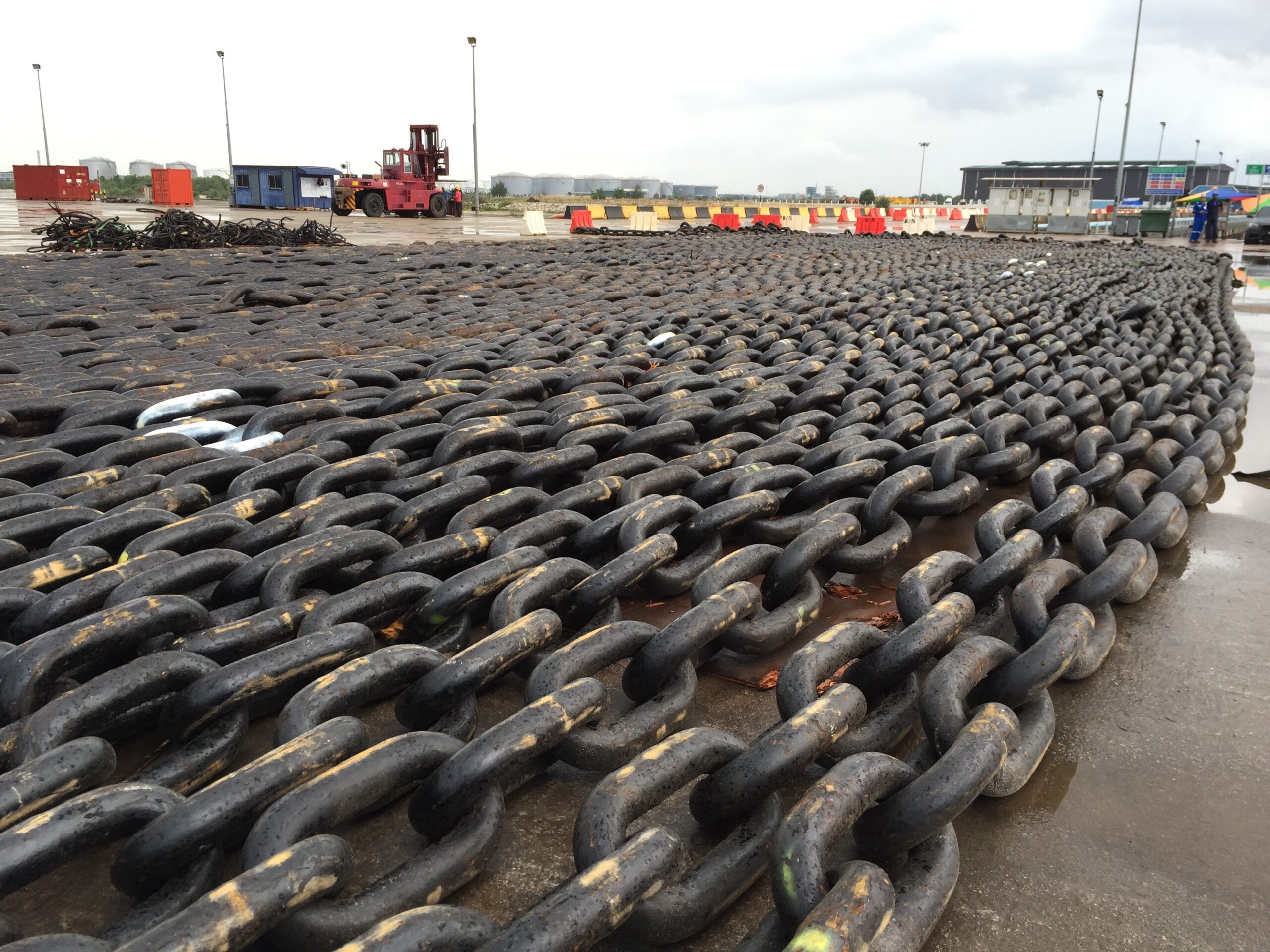
Chain Selection
With evolving demands in offshore projects, studless (open-link) mooring chains have become the preferred option in permanent moorings.
Why studless chains?
- Reduced weight-to-strength ratio, allowing more efficient system sizing
- Improved fatigue resistance, a key advantage in high-cycle environments
The mechanical strength of mooring chains is categorized into industry-standard grades. We assist our clients in defining and sourcing the right grade for their application:
Chain Grade | Description |
|---|---|
R3 / R3S | Common in moderate-depth moorings and calm environments |
R4 / R4S | High-strength options used for deepwater and high-load conditions |
R5 / R6 | Next-generation grades under development for future high-capacity floating systems |
The Minimum Breaking Load (MBL) or Minimum Breaking Strength (MBS) is one of the key performance metrics, verified through mechanical testing during production.
Quality Control & Assurance Measures
Our value lies in controlling the quality from source to sea. We implement a rigorous QA/QC protocol during chain procurement that includes:
- Approved Vendor Qualification
All chain suppliers are pre-qualified to international classification standards. - Third-Party Inspection & Testing Oversight
We coordinate mechanical testing and NDT (non-destructive testing), including:- Proof load tests
- Break load verification
- Magnetic Particle Inspection (MPI)
- Ultrasonic Testing (UT)
- Traceability Documentation
Complete material certificates, test reports, and heat numbers accompany each batch of chain to ensure full traceability from mill to project site. - Interface Check & Trial Fit
We conduct comprehensive interface verification and trial fit procedures to ensure seamless integration between chains and their accessories. This includes compliance with detailed buyer specifications and the use of 3D tolerance templates. Our approach includes:- Interface Dimension Report that documents all mating dimensions between chain links, shackles, H-links, and bolts.
- Execution of trial fits between interfacing components, using either full-scale templates or actual elements
- 3-dimensional templates are used to verify tolerances for insertion and clearance.
- On-site Acceptance Support
Our engineering team supports inspection during delivery, verifying dimensional accuracy, certification, and packaging condition before acceptance.
Project Management
We act as a technical integrator and project advocate, not just a chain supplier. Here’s how we support your chain procurement scope:
- Match chain specification with design loads and life-cycle requirements
- Interface with classification societies to ensure all compliance checks are satisfied
- Assist in bid evaluation, vendor comparison, and cost-risk balancing
- Monitor production progress, support factory acceptance testing (FAT), and manage logistics to your project site
A Smart, Scalable, and Cost-Effective Solution
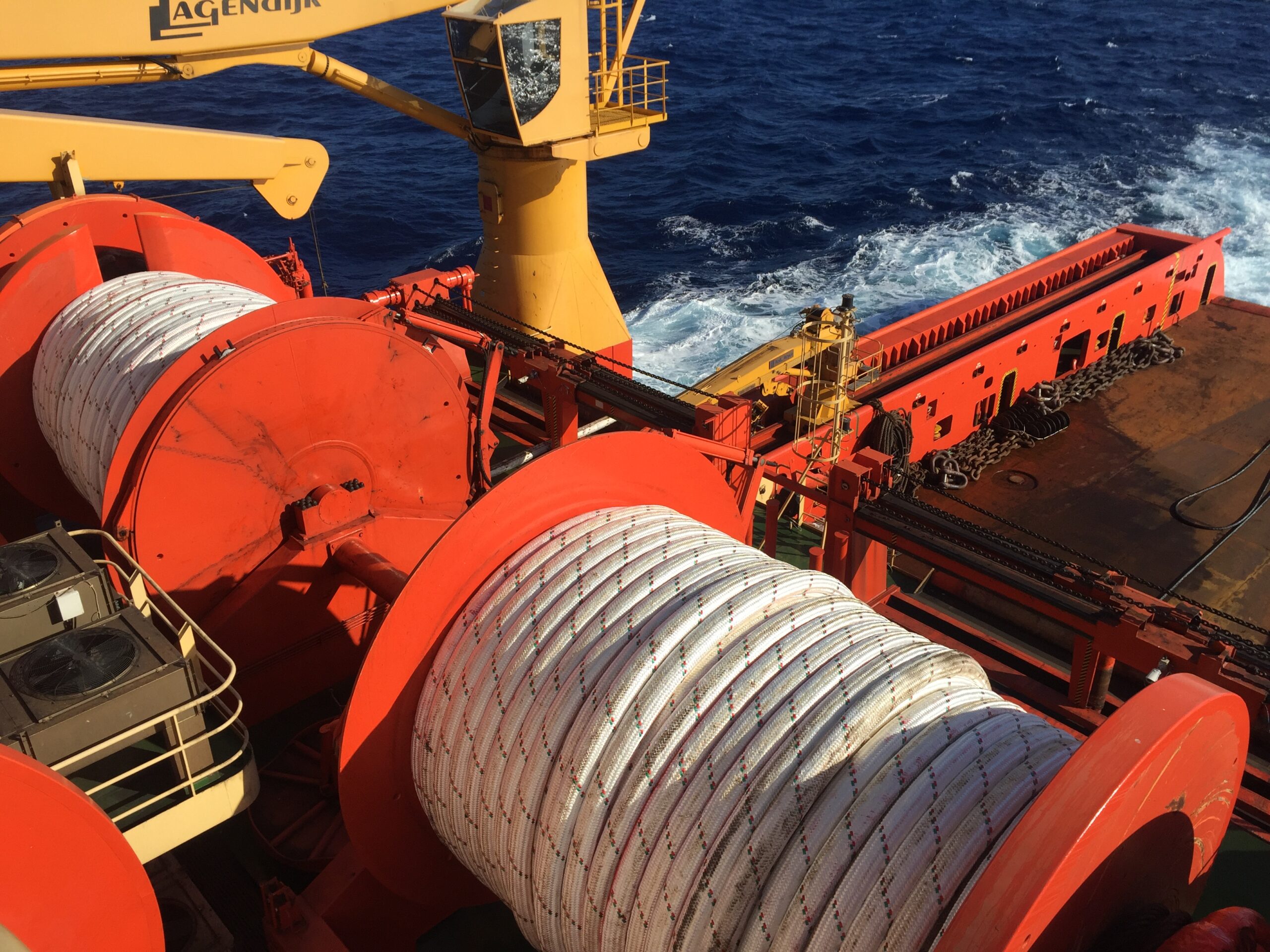
The hybrid mooring line configuration, combining steel chain and synthetic fiber ropes, is not a new innovation—it’s a well-established solution used for decades in the oil & gas sector, particularly in deepwater and ultra-deepwater projects involving FPSOs, FLNGs, SPAR platforms and Semi-submersibles.
These high-value offshore assets require reliable, long-term station-keeping systems in water depths exceeding 1,000 meters, where traditional full-chain mooring becomes economically and technically challenging.
As Floating Offshore Wind Turbines (FOWTs) scale from pilot arrays to commercial wind farms, operators face the challenge of balancing cost, performance, and reliability across hundreds of mooring lines. At Mooreast we help project developers deploy hybrid mooring systems — combining chain and synthetic fiber ropes — to deliver a technically sound and economically viable solution.
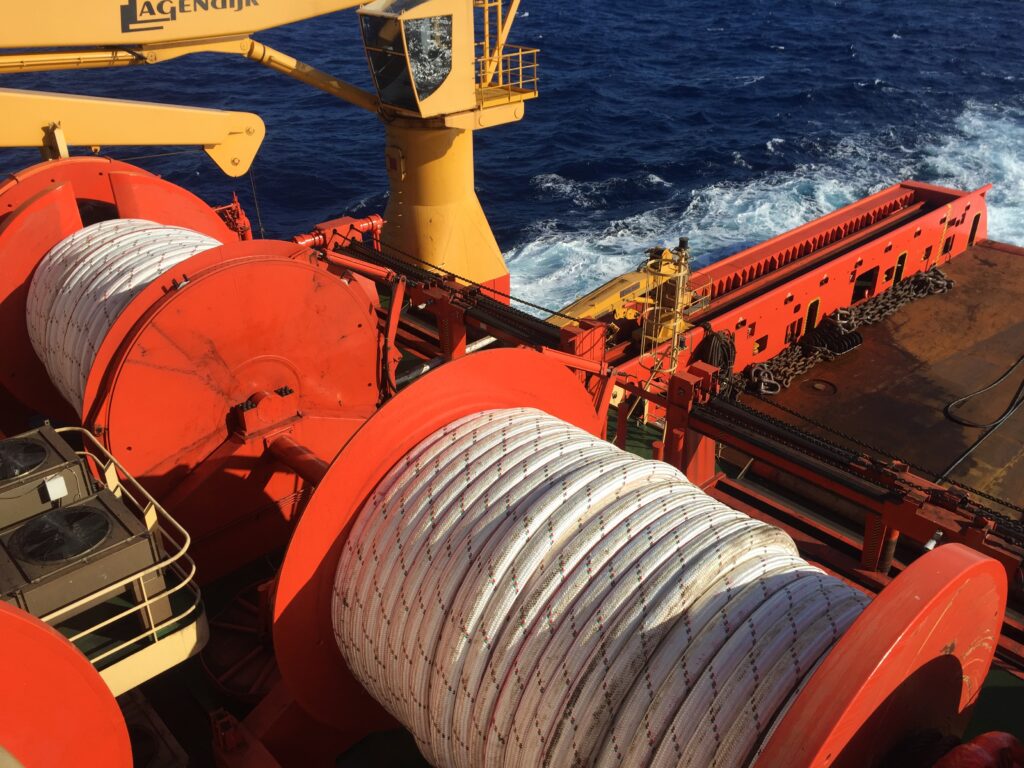
(Photo credits: Lankhorst Offshore)
Cost Savings at Scale
Hybrid mooring systems enable cost optimization in large-scale floating wind by addressing:
- Material Savings: Synthetic ropes reduce the required chain length and weight — delivering savings on steel procurement and reducing vessel load limits.
- Improved Lifecycle Economics: Reduced fatigue and abrasion on synthetic segments lowers the risk of premature replacement — ensuring long-term asset performance.
End-to-End Hybrid Mooring Solutions
We support developers at every stage of hybrid mooring system deployment — from concept design to final delivery:
1. Site-Specific Configuration Design
We analyze site conditions (water depth, wave dynamics, seabed type) and help you determine the optimal configuration for each turbine and inter-array layout — including:
- Seabed-to-floater line transitions
- Line lengths and catenary profiles
- Required pre-tension and excursion limits
- Anchor compatibility (e.g., suction, drag, gravity)
2. Mooring Line Component Selection
We specify and procure each section of the hybrid mooring line:
- Chain grades (R3, R4, R4S) for seabed sections
- 12-strand polyester or HMPE ropes for mid-water
- End connections: terminations, thimbles, swivels, H-links
All components are selected based on Minimum Breaking Load (MBL), fatigue life, and installation constraints
3. Interface Engineering & QA
We ensure seamless connection between the chain and rope segments with full:
- Interface dimension checks
- Trial fits
- 3D tolerance templates
- Load sharing device selection and compatibility
4. Dynamic Simulation & Fatigue Analysis
Using industry tools (e.g., OrcaFlex), we simulate the mooring system’s behavior under:
- Extreme environmental loading
- Floater dynamics and excursions
- Coupled wind–wave–current interaction
This ensures the hybrid system delivers both station-keeping integrity and long-term fatigue life.
5. Procurement, Testing & Certification
We manage full procurement with quality assurance, including:
- Factory Acceptance Testing (FAT)
- MBL and fatigue testing for fiber rope segments
- IACS certification
- Full documentation and traceability for project approval
Chain Stoppers
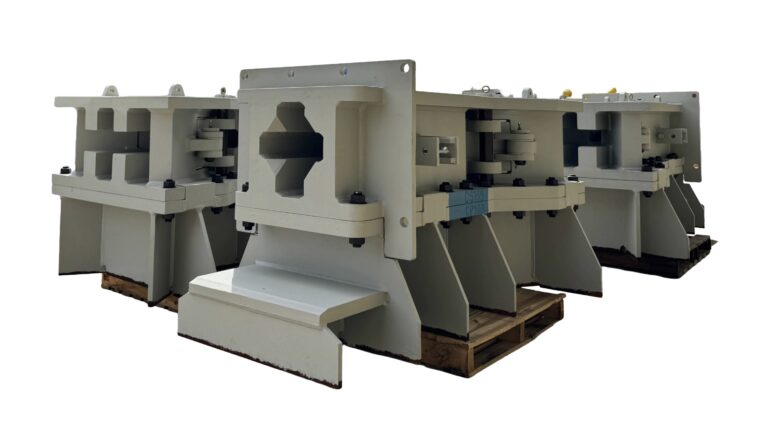
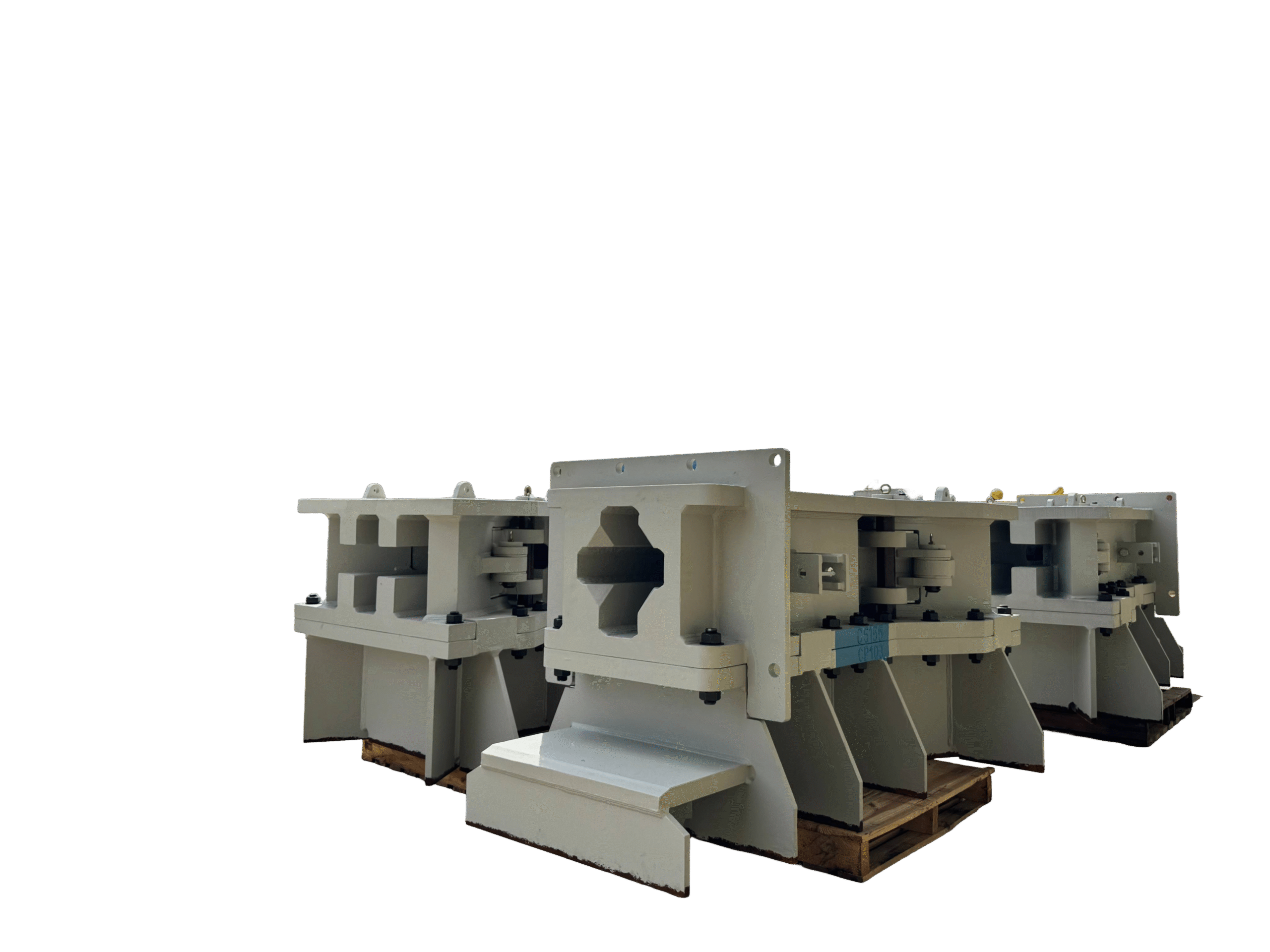
Chain stoppers are vital structural elements in any offshore mooring system—responsible for securing the mooring line and transferring tension loads into the floater or fixed structure. At Mooreast, we specialize in the design, engineering, fabrication, testing, and delivery of chain stoppers as part of a complete EPC scope, ensuring project readiness and structural reliability from shore to seabed.
Whether for a floating offshore wind turbine (FOWT) or an oil & gas floating production unit, our proprietary chain stopper systems are engineered to meet the harsh demands of offshore environments with high holding power, minimal maintenance, and seamless structural integration.
Why Chain Stoppers Are Mission-Critical
Unlike modular mooring hardware that can be installed offshore, chain stoppers must be fully integrated with the floater structure before deployment. That means:
- Time-critical delivery is essential — fabrication and testing must align with floater construction milestones.
- Interface precision is key — the chain stopper must match hull geometries, fairleads, and mooring line path.
- No retrofit flexibility — once offshore, late-stage modifications are impractical or impossible.
Failure to deliver the chain stopper on time or to the correct interface can result in delays to sail-away, increased project costs, and missed weather windows.
Chain Stoppers for Permanent Mooring
Chain stoppers for use in permanent mooring systems need to be designed and supplied according to major classification society standards such as ABS, BV, DNV, LR and others.
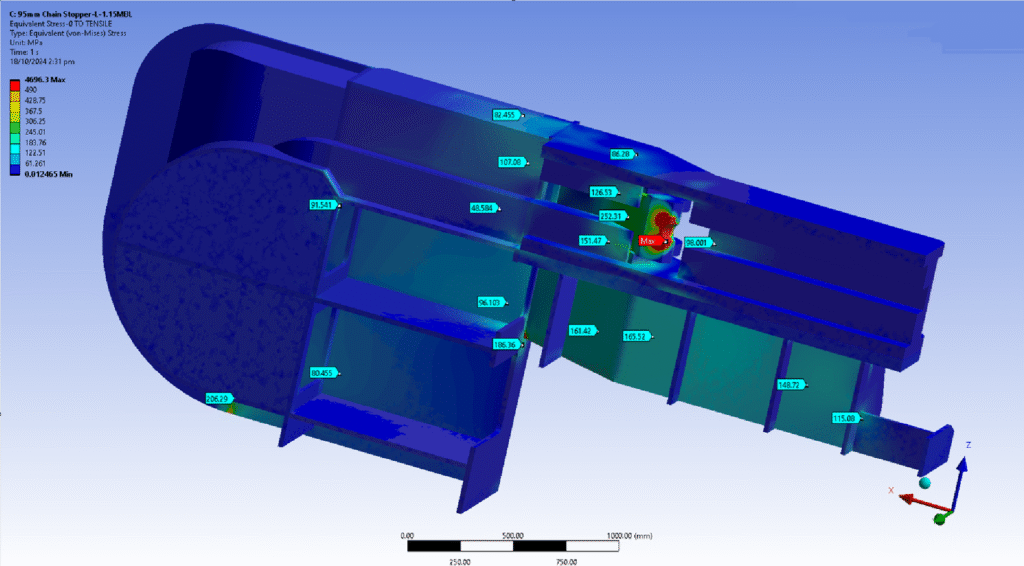
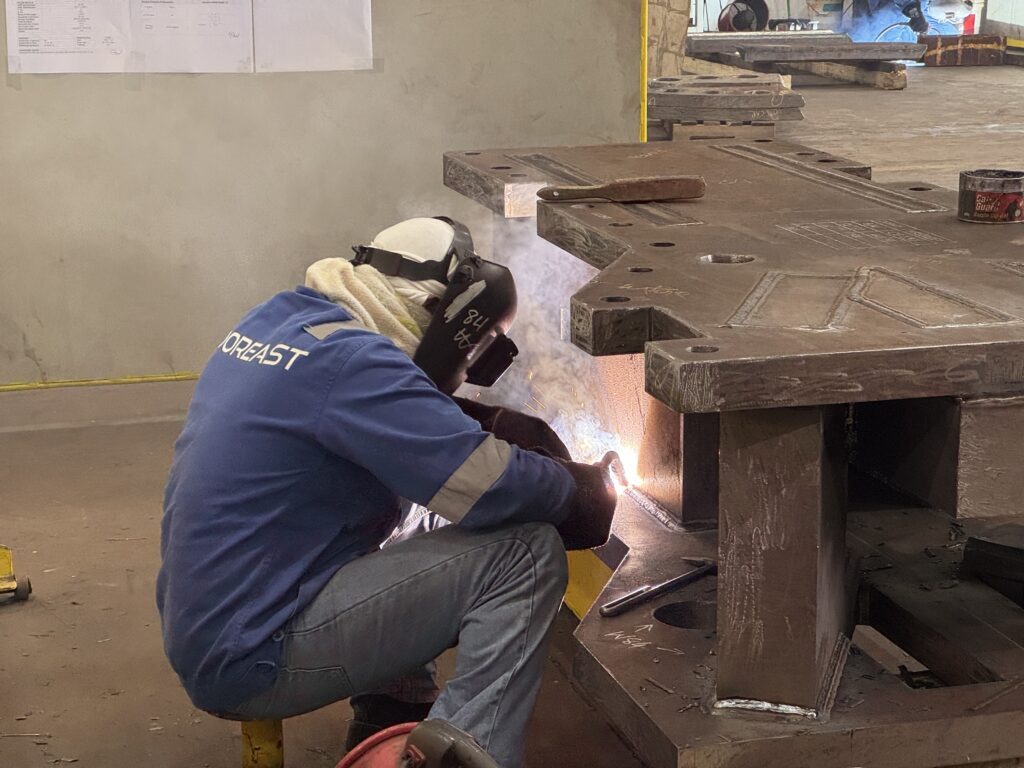
These standards and codes specify the requirements for the materials used, allowable stress levels, load cases to be analyzed, impact of corrosion, factors of safety for fatigue life, assessment of interaction / interface of chain stopper components with the chain and the inspection and tests to be performed during fabrication and factory acceptance tests to the satisfaction of all stake holders. Mooreast handles all the design, engineering, fabrication, testing, liaising with the assigned classification society, painting and packaging for transport using its dedicated in-house departments.
Permanent mooring chain stoppers are designed for customized load conditions of site, chain type – size – grade, floater deck or hull mounted supporting structure and its interfaces, type of connection to the foundation and so on. The durability and safety of the chain stopper is to be proven with a classification certification of inspection, material testing as deemed necessary, design review and approval certificate that validates the chain stopper design has been reviewed and found suitable for the specific permanent mooring system.
Field-Proven. Heavy Duty. Low Maintenance.
Widely deployed across global oil & gas floaters for FPSOs, FSOs, FSUs and FLNGs, our proprietary fixed chain stopper design has earned a reputation for:
- Simplicity and strength – rugged design with few moving parts
- High holding capacity – suitable for large-diameter chains (up to 170mm+)
- Proven performance – extensively field-tested on permanent and temporary moorings
- Classification Society-approved – designed in accordance with DNV, ABS, or BV or other requirements
These are ideal for permanent moorings where chain tensioning is performed using platform-mounted winches or chain jacks.
Designed for Floating Wind. Engineered for Efficiency.
Our dual-axis chain stoppers are specifically developed to meet the unique needs of floating wind structures, where onboard chain tensioning systems (like winches or cranes) are typically not available. Inspired by deepwater FPSO technology used in oil & gas for the past decade, this 2-DOF design ensures that the mooring load path remains efficient and predictable, reducing long-term fatigue and increasing structural life.
Key features:
2 Degree-of-Freedom (2-DOF) Design
The system incorporates two degrees of rotational freedom (vertical and horizontal) to allow the mooring line to self-align with the direction of tension.
This feature minimizes unwanted bending moments and stress concentrations at the chain stopper–floater interface.
Particularly advantageous for floating wind structures without active heading control, where line angles shift frequently due to weather and wave loading.
Integrated Fairlead
- Critical feature to re-align or re-tension mooring lines offshore, by slacking or tensioning the mooring lines without the need for onboard winches or cranes—a major advantage for FOWTs with passive topsides.
- The integrated fairlead acts as a smooth load path guide for the chain, minimizing wear and localized fatigue.
- Critically, it also enables re-tensioning of mooring lines after installation, which is essential in the event of:
- Mooring synthetic fibre rope elongation over time
- Line bedding-in
- Extreme weather events (e.g., storms or typhoons) that shift floater position
Fully Integrated "All-in-One" Component
- The design integrates both stopper and fairlead into a single fabricated unit, eliminating “male-female” interface systems.
- Eliminate the need for additional in-line tensioners with the all-in-one design compared to pull-in type platform mooring connectors
- Removes the need for offshore mating of components, which is often prone to:
- Misalignment
- Tolerance stacking errors
- Safety risks from pulling one part into the other under high-tension loads
- The all-in-one assembly is pre-fitted and tested onshore at the fabrication yard, ensuring fit-up accuracy and avoiding costly offshore adjustments.
- Ideal for large-scale floating wind deployments, where consistency, speed, and repeatability are essential to meet project timelines.
Installation Aids
Our complete range of installation aids supports efficient and safe deployment of mooring systems, anchors, and subsea equipment. We supply critical hardware designed to reduce installation time, enhance precision, and lower operational risk during offshore campaigns.
Surface Marker Buoy
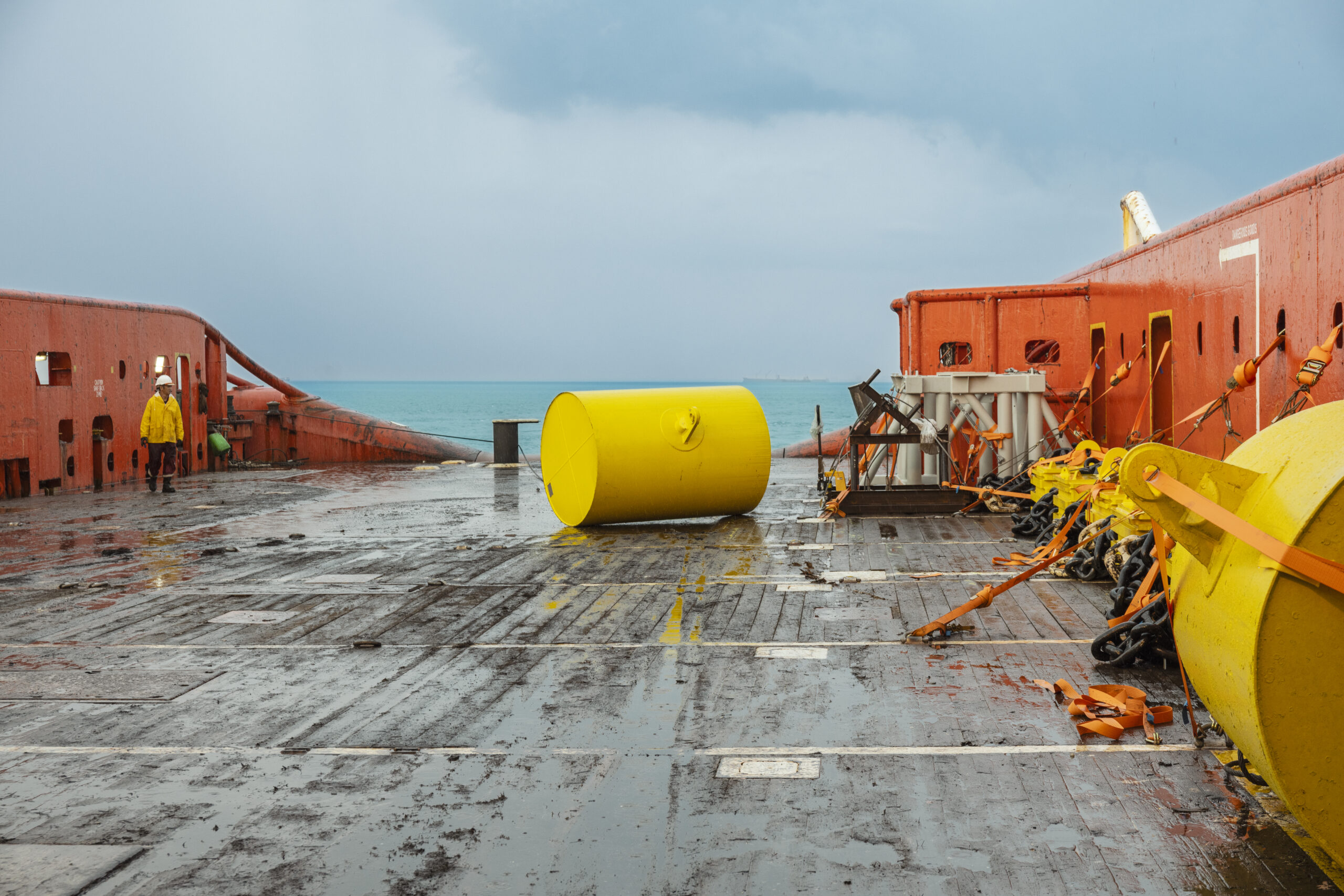
A Surface Marker Buoy is a top-mounted cross-beam arrangement that allows the temporary attachment of multiple mooring components, typically used during pre-lay or installation campaigns.
Design Features:
- Crucifix top section fabricated from heavy-duty steel for multiple connection points
- Accommodates secondary chain segments, pick-up lines, or soft slings
- Designed with central lifting padeye for easy recovery by AHTS or crane
- Buoyancy modules designed to support high uplift
- Also available with full fenders fitting requirements
Benefits:
- Ideal for pre-lay mooring spreads, where multiple line elements must be held afloat
- Enables controlled deployment and retrieval of primary mooring chains and ground legs
- Used as a temporary hold-off point during phased installation
- Facilitates line separation and organization during anchor positioning
Applications:
- Commonly used in Oil & Gas and Floating Wind mooring pre-laying operations
- Also used for temporary mooring of vessel at offshore location
Chain-Through Surface Buoy
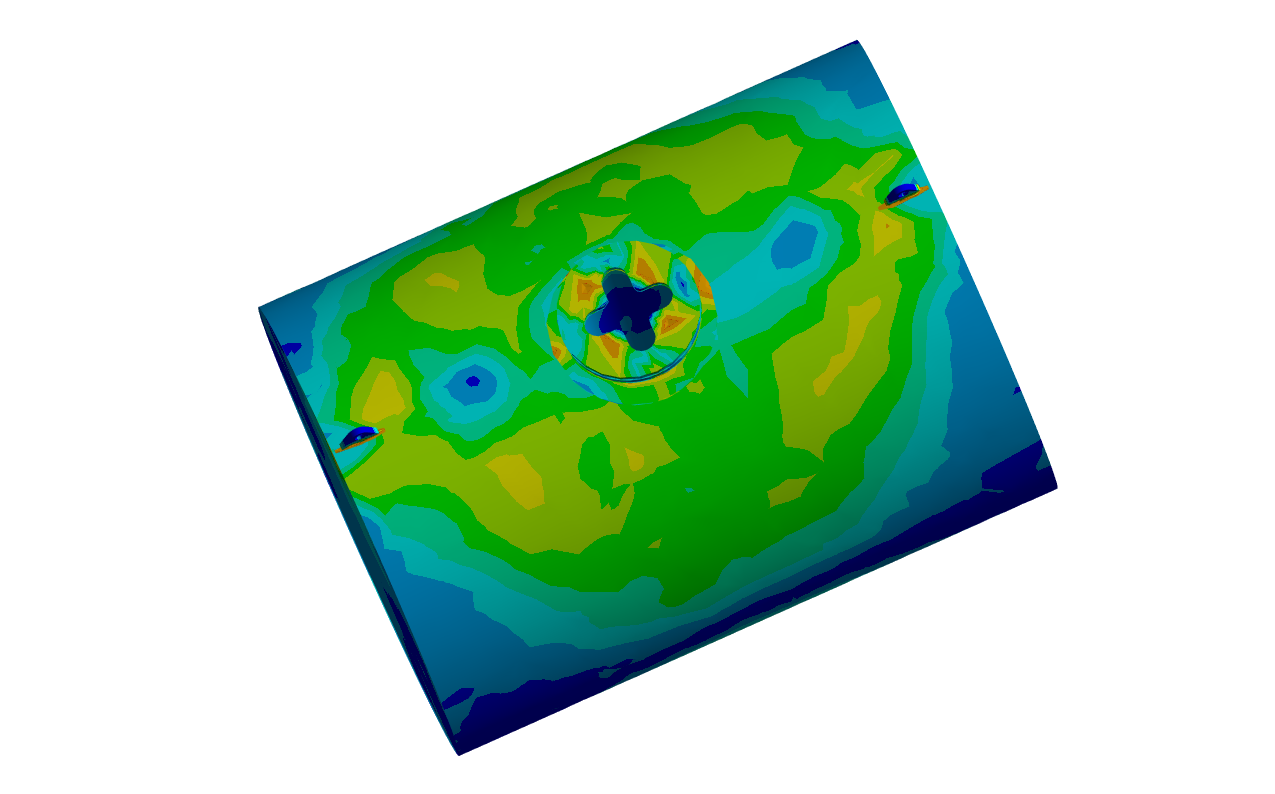
The Chain-Through Surface Buoy is engineered for the pass-through of a mooring chain, allowing the line to be tensioned, adjusted, or reconnected without detaching it from the buoy during operations.
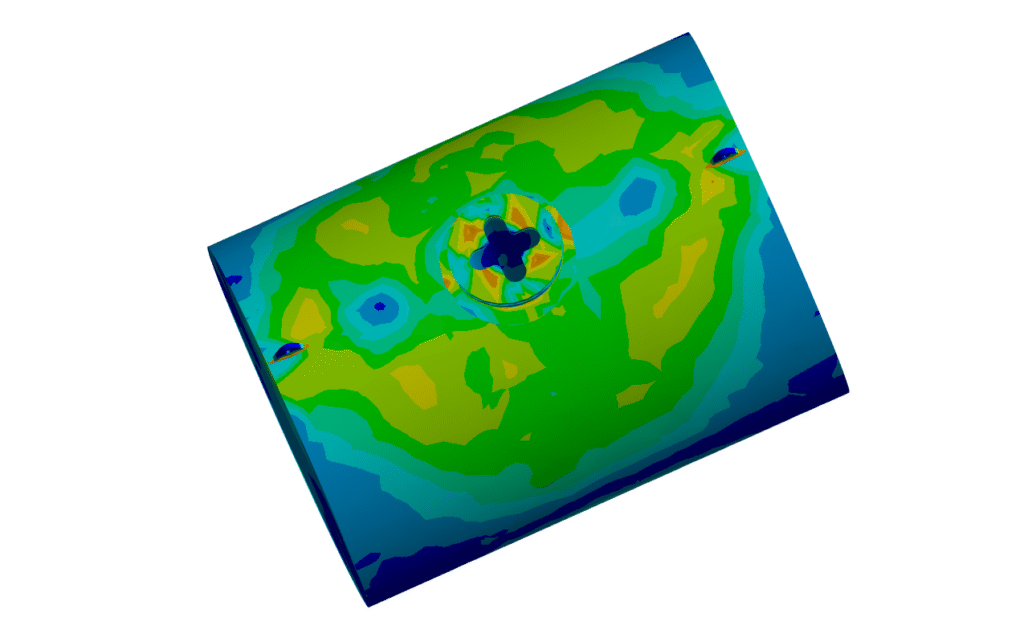
Design Features:
- Vertical internal conduit sized for mooring chain passage (typically 76–170 mm)
- Integrated chain stopper or locking mechanism inside the buoy to fix position
- Load-tested padeyes for tug handling and lifting
- Buoyancy sized to counteract chain weight and preload tension — modular or solid body
Benefits:
- Allows continuous connection of mooring line during tensioning or hold-off
- Prevents accidental drop or over-slackening of chain during offshore installation
- Enables controlled pay-out or recovery of chain under live operations
- Reduces need for onboard chain tensioning winches on floating platforms
Applications:
- Especially suited for Floating Offshore Wind installations with:
- Limited onboard handling equipment
- Mooring pre-lay operations with subsequent connection to floating units
Frequently used in deepwater permanent moorings where precise tension control is required
Engineering & Customization
We offer custom design and fabrication for both surface buoy types based on:
- Water depth and mooring tension loads
- Chain diameter and grade (R3–R5)
- Required uplift buoyancy
- Corrosion protection (marine coating or cathodic protection)
All buoys are delivered with:
- Load test certificates
- Buoyancy calculations
- Drawings and user manuals
- Handling and recovery guides
Subsea Tensioner for Anchor Installation
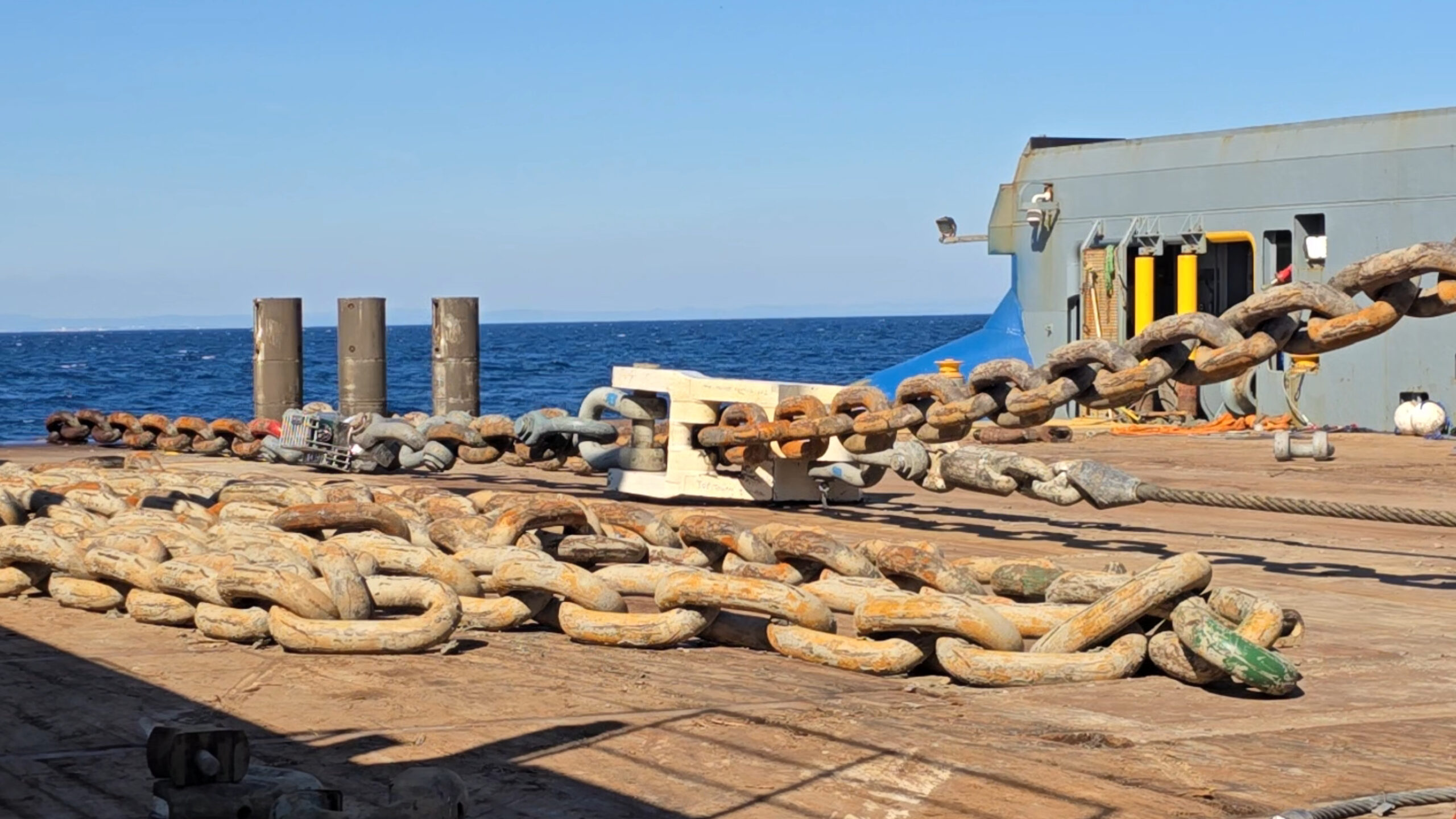
Our subsea chain tensioner system enables on-site proof loading of permanent moorings—an essential step in mooring system certification—by applying load levels of 80–100% of design tension without the need for large bollard pull vessels.
Using this technology, proof loads can be achieved with up to 60% less required deck pull, enabling installation operations using smaller anchor handling vessels or crane barges. This represents a step-change in reducing both cost and logistical complexity, especially in when proof load requirements are high.
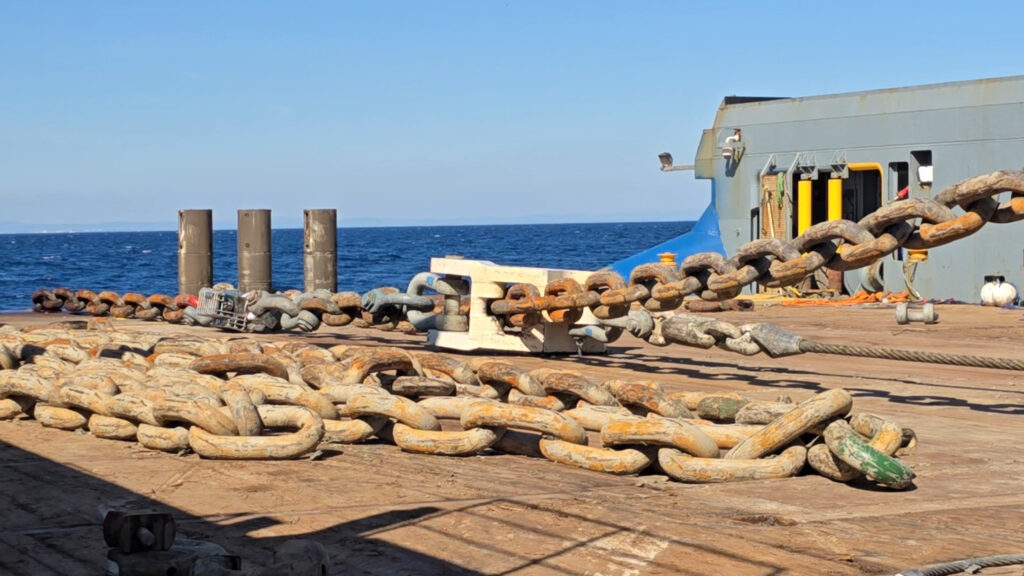
Dual Anchor Installation Capability – Maximize Efficiency
A standout feature of our solution is the ability to simultaneously tension two opposing anchor lines. By applying a cross-tensioning technique, the Subsea Tensioner can be configured to apply load to two anchor points at once, dramatically reducing total cycle time.
- Key Benefits for FOWT Mooring Installation:
- 50% reduction in tensioning operation
- Ideal for multi-line, pre-laid mooring spreads
- Reduced vessel time, fuel consumption, and emissions
For FOWT farms requiring repeated, rapid deployment of moorings at scale, this approach accelerates installation schedules and ensures consistent tensioning performance across units.
Proven Technology with Flexible Integration
The subsea chain tensioner functions as a compact, high-capacity chain shortening clutch, capable of applying high horizontal tension via a controlled vertical pull. This “yo-yo” heaving method builds line tension over several cycles, achieving the target proof load without extensive surface winch capacity.
Technical Highlights:
- Handles proof loads up to 1,500 tons (or more)
- Accommodates chain sizes from 76 mm to 152 mm or large
Rental Solutions with Engineering Support
The subsea chain tensioner is available as part of a comprehensive rental package, including:
- Tensioner unit with integrated load measurement pin
- Real-time data readout via umbilical or acoustic transmission
- Optional project-specific engineering, including feasibility studies, procedural development, and onsite supervisory support
The compact design also enables air-freight mobilization, minimizing lead time and simplifying logistics for global offshore campaigns.
Why Choose Our Subsea Tensioning Solution?
✓ Eliminate bollard pull requirements
✓ Eliminate need for oversized winches or high-capacity vessels
✓ Enable faster, cost-effective mooring installations
✓ Support simultaneous dual-anchor proof load
✓ Applicable to all anchor types and mooring configurations
✓ Compact, field-proven, and mobilization-ready
Rigging & Lifting Supplies
We provide rigging and lifting solutions to support heavy mooring component handling onshore and offshore, including integration with anchor handling vessels (AHVs). Our offerings guarantee safe and cost-effective solutions which are suitable across the globe in a wide variety of industry segments including buoy mooring systems, tug and salvage lines, offshore working and lifting lines, ship and barge mooring lines, utility and winch lines, emergency tow packages and many more…
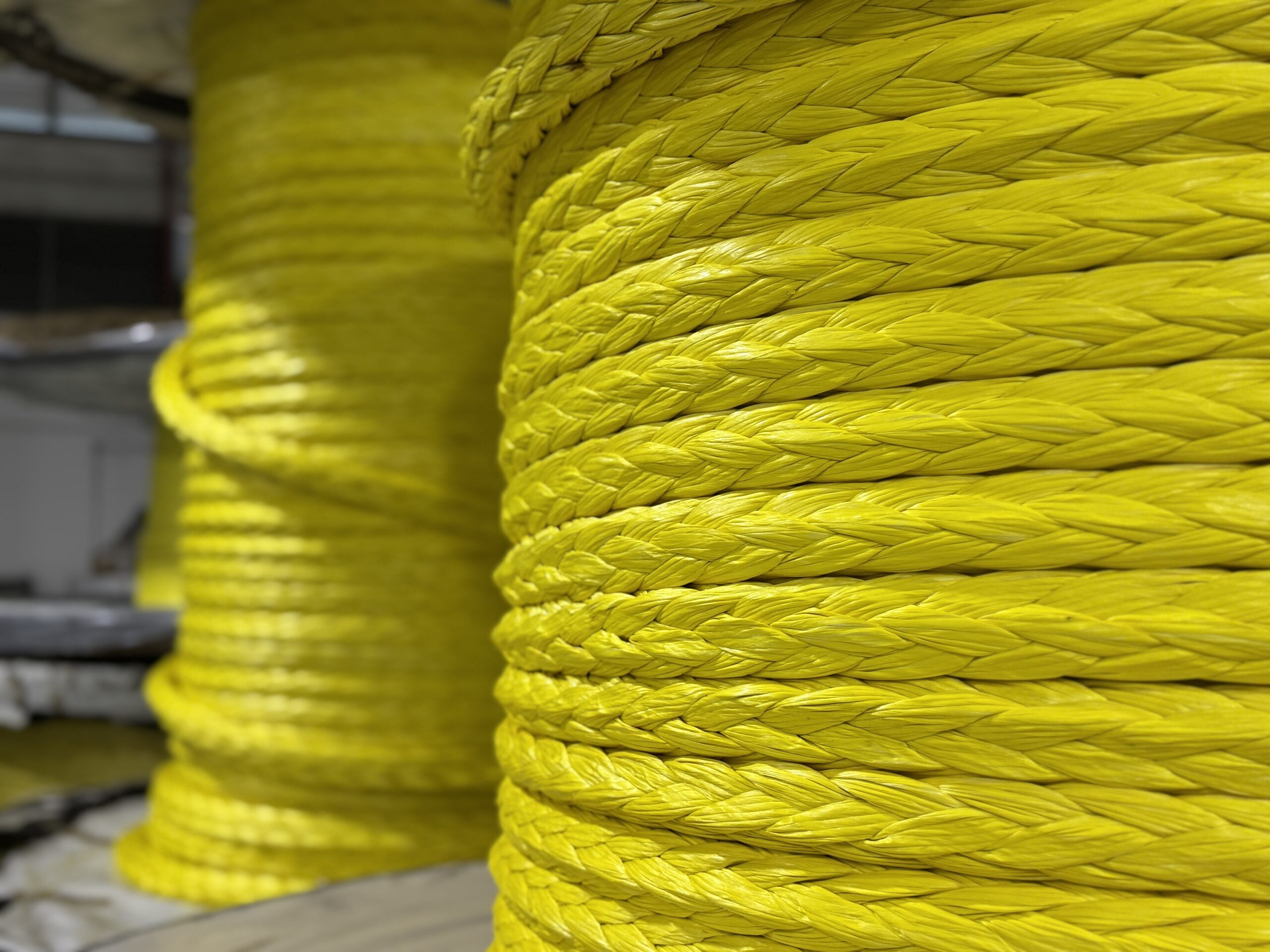
Synthetic Fibre Ropes
Moortuf®
Moortuf® FX
Moortuf® FX Tail
Nika-Siri® HMPE
Korean Nylon 100%
Korean Nylon 100% Tail
Moorguard® Rope Protective Sleeve
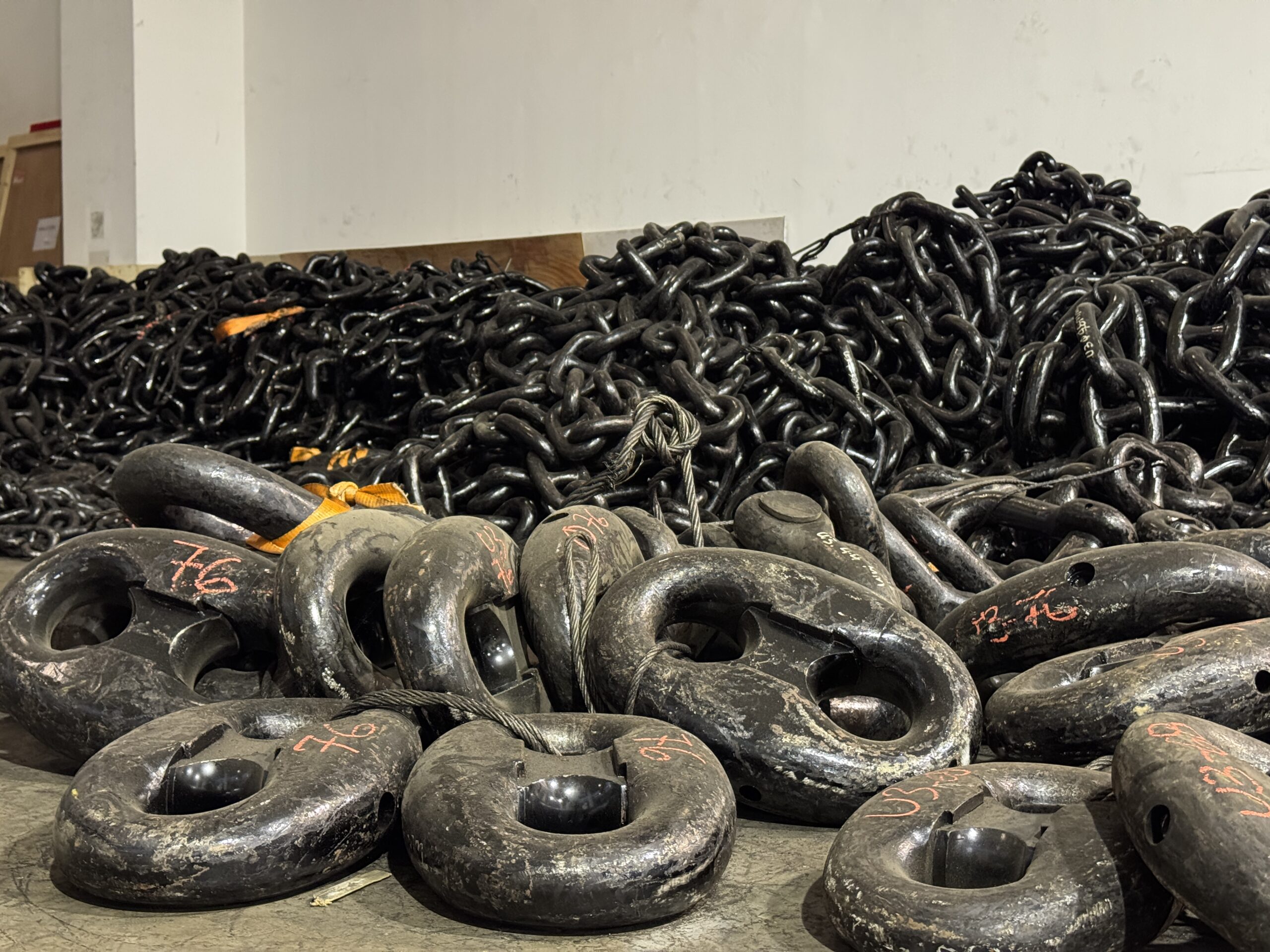
Anchor Chains & Fittings
Stud link Anchor Chains
Kenter joining shackle
Swivel forerunner
Anchor shackles
Crown shackles
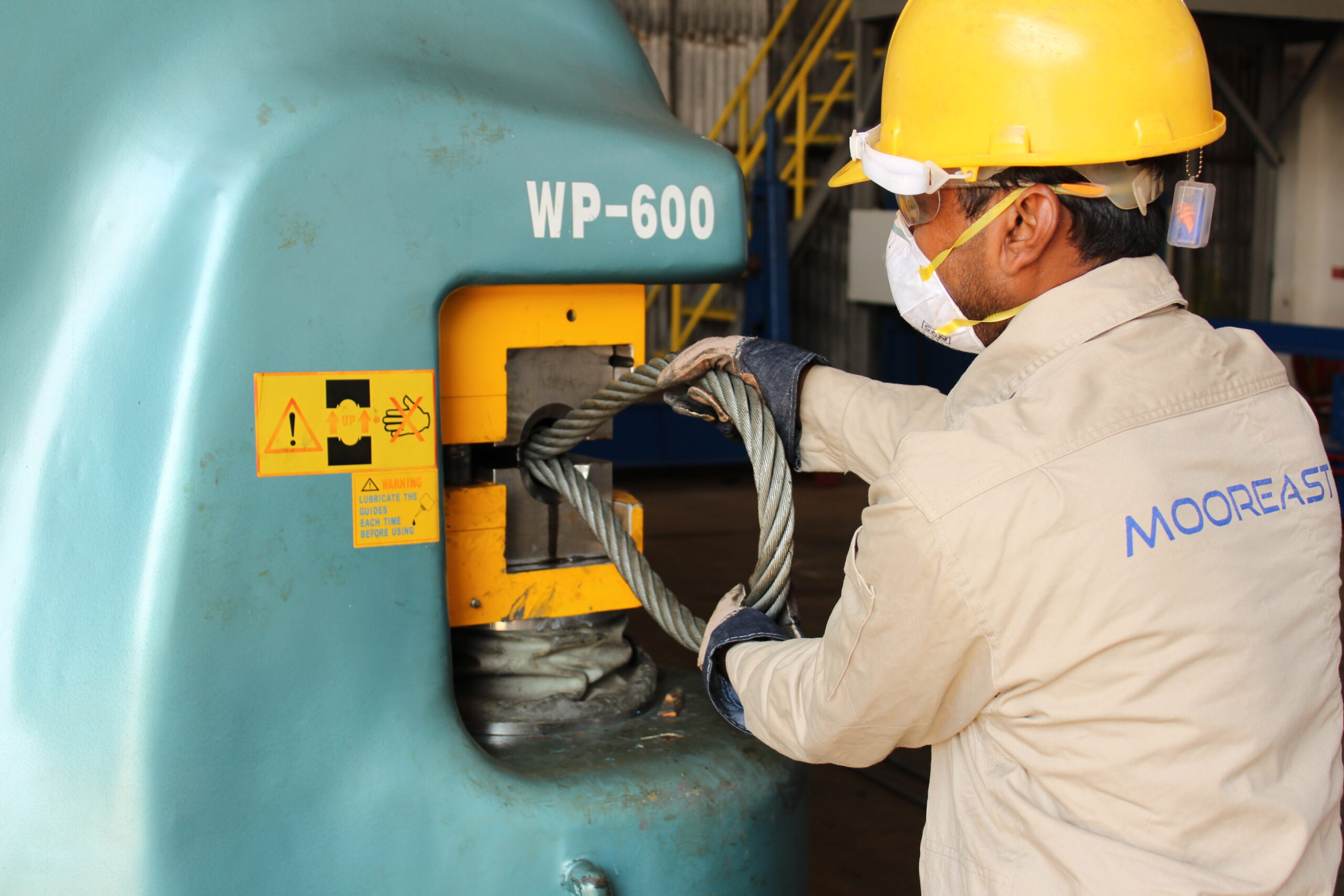
Steel Wire & Lifting Gears
6XWS (36) + IWRC steel wire ropes
End terminations
Wire rope sockets
Various hooks
Slings, shackles & rigging screws
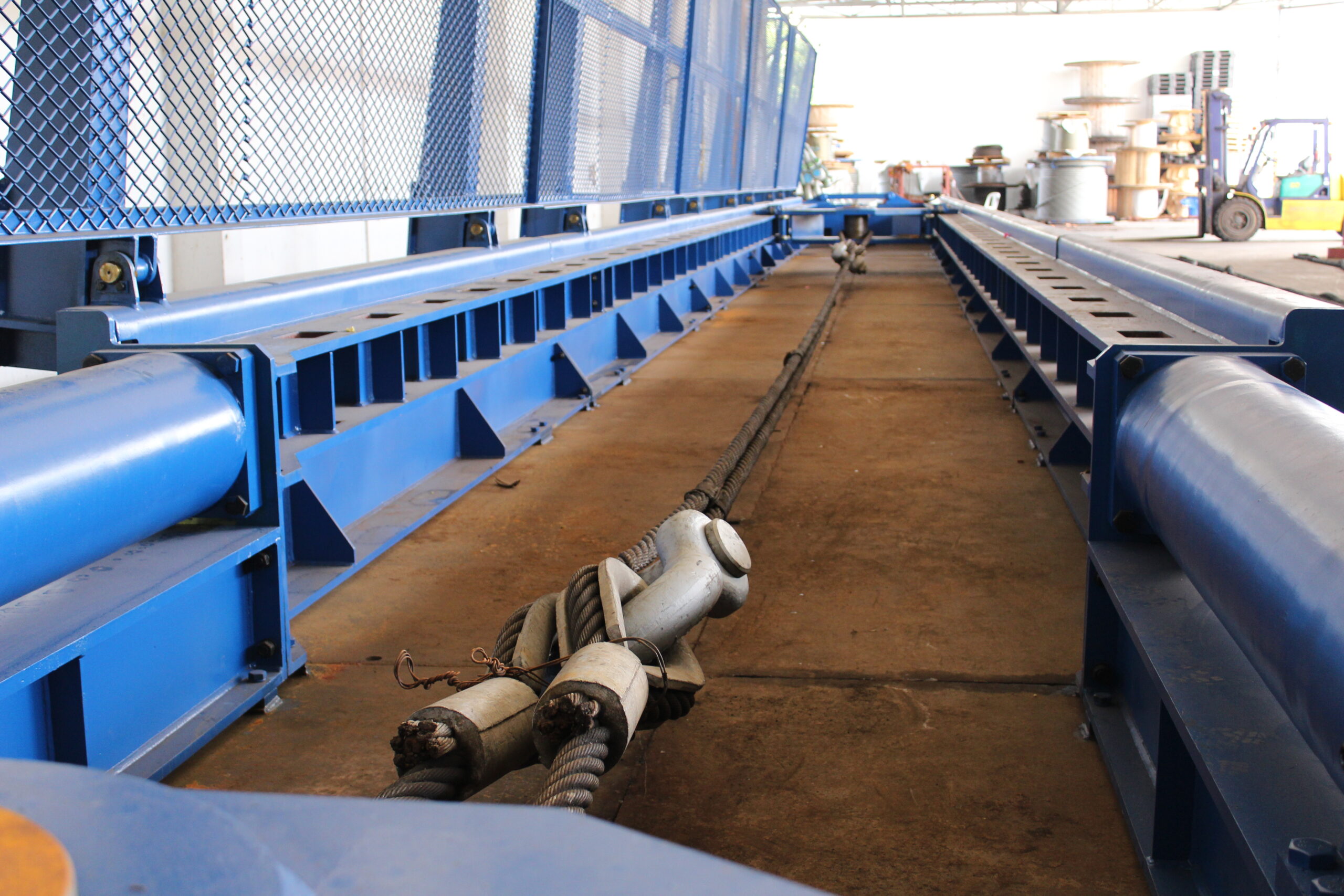
Certification & Testing Services
600T Pull Test bed
On-site Spooling, Load Testing & NDT
Splicing Services
Testing & Certification Services
Engineering & Fabrication
- Suitable for variety of soil conditions
- Easy to install using anchor handling tugs
- A holding capacity of more than 50x times its own weight, depending on the seabed conditions
- Approved design by all major classification societies
- Easy decommissioning and reusability
- Suitable for uplift loading
- Designed for hard soil conditions
- Can be loaded on the fluke tips only
- A holding capacity of more than 50x times its own weight, depending on the seabed conditions
- Stronger structural design
- Easy decommissioning and reusability
- Suitable for uplift loading
- Suitable for variety soil conditions
- Optimized fluke geometry for improved holding capacity
- A holding capacity of more than 80x times its own weight, depending on the seabed conditions
- Suitable for uplift loading
- Diameter: Typically ranges from 2 m to 10 m
- Length (Embedment Depth): Up to 20+ meters, depending on soil and load
- Wall Thickness: Optimized for structural integrity
- Top Plate Configurations:
- ROV operatable bottom chain connection interface
- ROV interface panels for installation support
- Lifting trunnions and guide frames
- Materials & Coatings: Offshore-grade steel with Classification Society compliance
- Cost-effective installation using suction (no hammering required)
- No pile driving noise – environmentally friendly
- Removable and reusable (suitable for decommissioning or relocations)
- Integrated with ROV-friendly interfaces for subsea installation
- Pile Diameter: Ranging from 0.6 m to 10.0 m
- Length: Up to 30 m or more, depending on soil layers
- Tip Design:
- Open-ended
- Pointed driving shoes for hard soils
- Connection Interface:
- Casted, forged or fabricated padeye with internal stiffeners
- ROV operatable bottom chain connection interface
- Proven technology with decades of track record in oil & gas and marine infrastructure
- Suitable for dense soil and mixed strata where suction is less effective
- High axial and lateral capacity, supporting up to taut mooring design
- Permanent foundation solution
-
Steel Gravity Base Anchor (SGBA):
Fabricated entirely from offshore-grade steel, designed for high strength-to-weight ratio and superior handling. -
Steel Clump Weights:
Compact mass blocks used to add downward force to the mooring catenary or assist in tension management. -
Steel Hold-Back Anchors:
Used to restrain pre-installed mooring lines or flexible risers during tie-in and installation operations.
- Modular construction allows delivery in parts and assembly offshore or nearshore
- Integrated padeyes and guide slots simplify deployment using AHTS or crane vessels
- Reduced seabed preparation time compared to concrete, which often requires leveling or scour protection
- Lower risk of cracking or structural failure under impact during handling
- Can be stacked or nested efficiently, reducing deck space requirements
- More compatible with standard sea fastening procedures on offshore support vessels
- Easier handling during load-out, lifting and deployments - Avoid hairline cracks which affects integrity of the anchor structure
- Reduced weight-to-strength ratio, allowing more efficient system sizing
- Improved fatigue resistance, a key advantage in high-cycle environments
| Chain Grade | Description |
|---|---|
| R3 / R3S | Common in moderate-depth moorings and calm environments |
| R4 / R4S | High-strength options used for deepwater and high-load conditions |
| R5 / R6 | Next-generation grades under development for future high-capacity floating systems |
-
Approved Vendor Qualification
All chain suppliers are pre-qualified to international classification standards. -
Third-Party Inspection & Testing Oversight
We coordinate mechanical testing and NDT (non-destructive testing), including:- Proof load tests
- Break load verification
- Magnetic Particle Inspection (MPI)
- Ultrasonic Testing (UT)
-
Traceability Documentation
Complete material certificates, test reports, and heat numbers accompany each batch of chain to ensure full traceability from mill to project site. -
Interface Check & Trial Fit
We conduct comprehensive interface verification and trial fit procedures to ensure seamless integration between chains and their accessories. This includes compliance with detailed buyer specifications and the use of 3D tolerance templates. Our approach includes:- Interface Dimension Report that documents all mating dimensions between chain links, shackles, H-links, and bolts.
- Execution of trial fits between interfacing components, using either full-scale templates or actual elements
- 3-dimensional templates are used to verify tolerances for insertion and clearance.
-
On-site Acceptance Support
Our engineering team supports inspection during delivery, verifying dimensional accuracy, certification, and packaging condition before acceptance.
- Match chain specification with design loads and life-cycle requirements
- Interface with classification societies to ensure all compliance checks are satisfied
- Assist in bid evaluation, vendor comparison, and cost-risk balancing
- Monitor production progress, support factory acceptance testing (FAT), and manage logistics to your project site
- Material Savings: Synthetic ropes reduce the required chain length and weight — delivering savings on steel procurement and reducing vessel load limits.
- Improved Lifecycle Economics: Reduced fatigue and abrasion on synthetic segments lowers the risk of premature replacement — ensuring long-term asset performance.
-
Site-Specific Configuration Design
We analyze site conditions (water depth, wave dynamics, seabed type) and help you determine the optimal configuration for each turbine and inter-array layout — including:- Seabed-to-floater line transitions
- Line lengths and catenary profiles
- Required pre-tension and excursion limits
- Anchor compatibility (e.g., suction, drag, gravity)
-
Mooring Line Component Selection
We specify and procure each section of the hybrid mooring line:- Chain grades (R3, R4, R4S) for seabed sections
- 12-strand polyester or HMPE ropes for mid-water
- End connections: terminations, thimbles, swivels, H-links
-
Interface Engineering & QA
We ensure seamless connection between the chain and rope segments with full:- Interface dimension checks
- Trial fits
- 3D tolerance templates
- Load sharing device selection and compatibility
-
Dynamic Simulation & Fatigue Analysis
Using industry tools (e.g., OrcaFlex), we simulate the mooring system’s behavior under:- Extreme environmental loading
- Floater dynamics and excursions
- Coupled wind–wave–current interaction
-
Procurement, Testing & Certification
We manage full procurement with quality assurance, including:- Factory Acceptance Testing (FAT)
- MBL and fatigue testing for fiber rope segments
- IACS certification
- Full documentation and traceability for project approval
- Time-critical delivery is essential — fabrication and testing must align with floater construction milestones.
- Interface precision is key — the chain stopper must match hull geometries, fairleads, and mooring line path.
- No retrofit flexibility — once offshore, late-stage modifications are impractical or impossible.
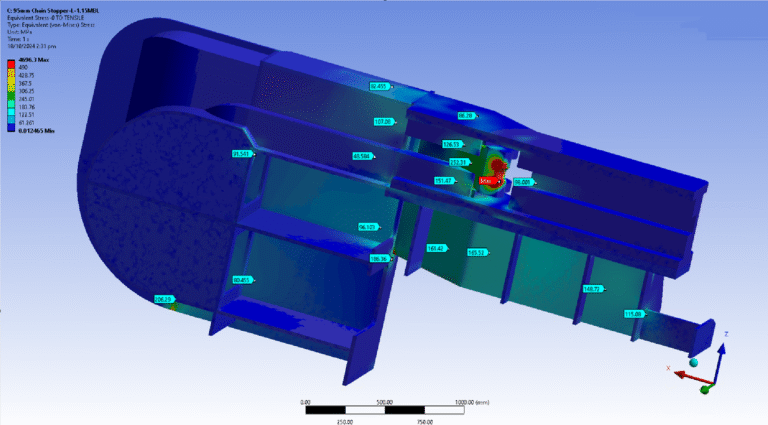
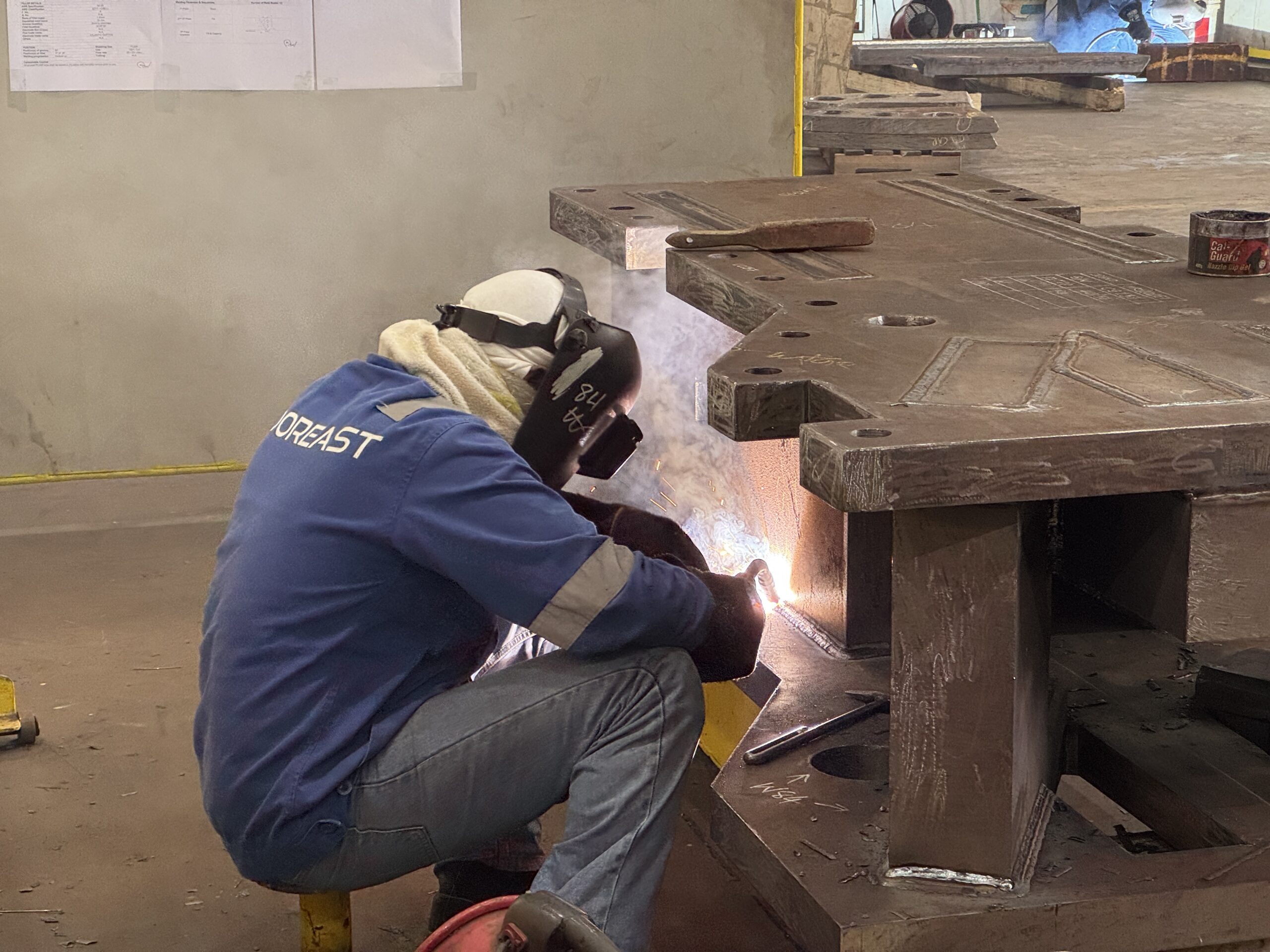
Heavy Duty.
Low Maintenance.
- Simplicity and strength – rugged design with few moving parts
- High holding capacity – suitable for large-diameter chains (up to 170mm+)
- Proven performance – extensively field-tested on permanent and temporary moorings
- Classification Society-approved – designed in accordance with DNV, ABS, or BV or other requirements
- Critical feature to re-align or re-tension mooring lines offshore, by slacking or tensioning the mooring lines without the need for onboard winches or cranes—a major advantage for FOWTs with passive topsides.
- The integrated fairlead acts as a smooth load path guide for the chain, minimizing wear and localized fatigue.
-
Critically, it also enables re-tensioning of mooring lines after installation, which is essential in the event of:
- Mooring synthetic fibre rope elongation over time
- Line bedding-in
- Extreme weather events (e.g., storms or typhoons) that shift floater position
- The design integrates both stopper and fairlead into a single fabricated unit, eliminating “male-female” interface systems.
- Eliminate the need for additional in-line tensioners with the all-in-one design compared to pull-in type platform mooring connectors
-
Removes the need for offshore mating of components, which is often prone to:
- Misalignment
- Tolerance stacking errors
- Safety risks from pulling one part into the other under high-tension loads
- The all-in-one assembly is pre-fitted and tested onshore at the fabrication yard, ensuring fit-up accuracy and avoiding costly offshore adjustments.
- Ideal for large-scale floating wind deployments, where consistency, speed, and repeatability are essential to meet project timelines.
- Crucifix top section fabricated from heavy-duty steel for multiple connection points
- Accommodates secondary chain segments, pick-up lines, or soft slings
- Designed with central lifting padeye for easy recovery by AHTS or crane
- Buoyancy modules designed to support high uplift
- Also available with full fenders fitting requirements
- Ideal for pre-lay mooring spreads, where multiple line elements must be held afloat
- Enables controlled deployment and retrieval of primary mooring chains and ground legs
- Used as a temporary hold-off point during phased installation
- Facilitates line separation and organization during anchor positioning
- Commonly used in Oil & Gas and Floating Wind mooring pre-laying operations
- Also used for temporary mooring of vessel at offshore location
- Vertical internal conduit sized for mooring chain passage (typically 76–170 mm)
- Integrated chain stopper or locking mechanism inside the buoy to fix position
- Load-tested padeyes for tug handling and lifting
- Buoyancy sized to counteract chain weight and preload tension — modular or solid body
- Allows continuous connection of mooring line during tensioning or hold-off
- Prevents accidental drop or over-slackening of chain during offshore installation
- Enables controlled pay-out or recovery of chain under live operations
- Reduces need for onboard chain tensioning winches on floating platforms
-
Especially suited for Floating Offshore Wind installations with:
- Limited onboard handling equipment
- Mooring pre-lay operations with subsequent connection to floating units
- Water depth and mooring tension loads
- Chain diameter and grade (R3–R5)
- Required uplift buoyancy
- Corrosion protection (marine coating or cathodic protection)
- Load test certificates
- Buoyancy calculations
- Drawings and user manuals
- Handling and recovery guides
- 50% reduction in tensioning operation
- Ideal for multi-line, pre-laid mooring spreads
- Reduced vessel time, fuel consumption, and emissions
- Handles proof loads up to 1,500 tons (or more)
- Accommodates chain sizes from 76 mm to 152 mm or large
- Tensioner unit with integrated load measurement pin
- Real-time data readout via umbilical or acoustic transmission
- Optional project-specific engineering, including feasibility studies, procedural development, and onsite supervisory support
- Eliminate bollard pull requirements
- Eliminate need for oversized winches or high-capacity vessels
- Enable faster, cost-effective mooring installations
- Support simultaneous dual-anchor proof load
- Applicable to all anchor types and mooring configurations
- Compact, field-proven, and mobilization-ready
- Moortuf®
- Moortuf® FX
- Moortuf® FX Tail
- Nika-Siri® HMPE
- Korean Nylon 100%
- Korean Nylon 100% Tail
- Moorguard® Rope Protective Sleeve
- Stud link Anchor Chains
- Kenter joining shackle
- Swivel forerunner
- Anchor shackles
- Crown shackles
- 6XWS (36) + IWRC steel wire ropes
- End terminations
- Wire rope sockets
- Various hooks
- Slings, shackles & rigging screws
- 600T Pull Test bed
- On-site Spooling, Load Testing & NDT
- Splicing Services
- Testing & Certification Services
- Engineering & Fabrication